Mars, Jupiter, Saturn, George?

The sun is shining, the outside doors are open, and from the window of the Royal Society library I can see the tops of trees along the Mall.

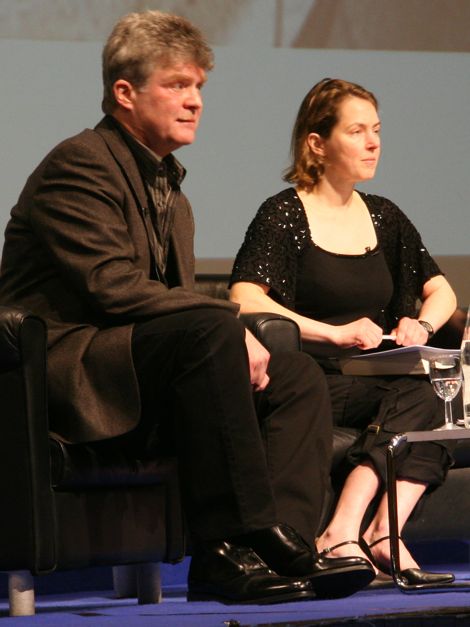
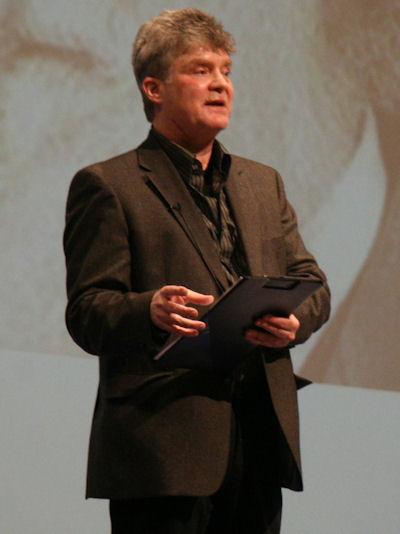
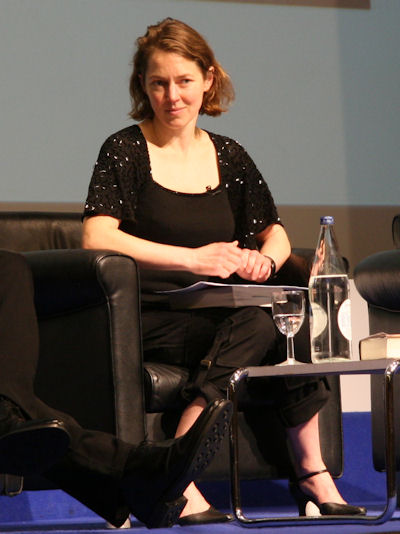
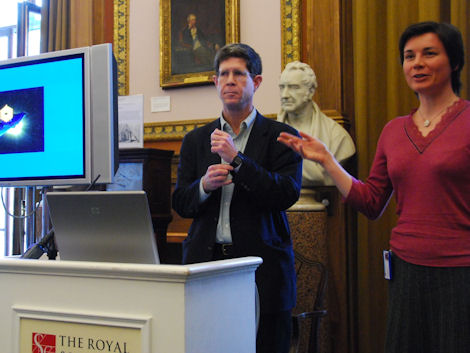
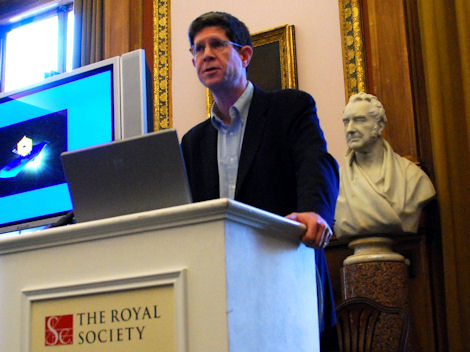
Michael Lemonick is introduced by the RS's Felicity Henderson
Michael Lemonick is introduced by the Royal Society's Felicity Henderson (photo, thanks Sven Klinge)

Today, at this first in a season of lunchtime talks at the RS, I’m learning from  Michael Lemonick some things I never knew about William and Caroline Herschel.

You can hear the audio and video (slides) yourself on the RS podcast page.  Lemonick’s book ‘The Georgian Star’ is published by W.W.Norton.Co.  In the meantime, this short commentary.

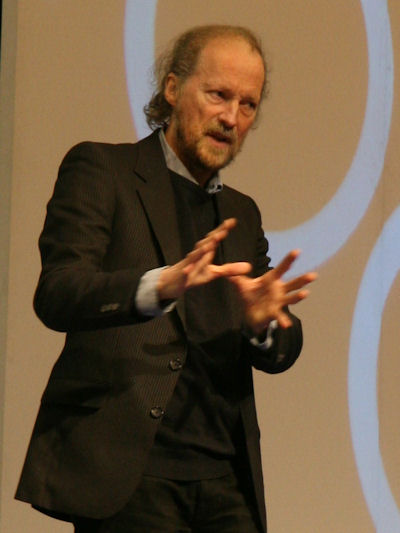
Michael Lemonick at the Royal Society (photo Sven Klinge)
Michael Lemonick at the Royal Society (photo, thanks Sven Klinge)

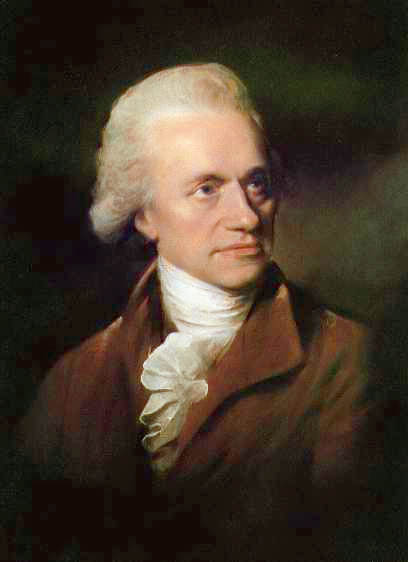
Sir William Herschel is best known as the discoverer of Uranus, a planet that did indeed in the days of William’s sponsor George III go by the popular name of George or ‘Georgium Sidus’ to be precise.  But discovering light blue planets that spin at a funny angle is only part of William’s and his sister Caroline’s  story.

Having moved to London from Germany, William Herschel the music teacher was enthralled by the stars he saw overhead whilst travelling between clients.  Disappointed with the telescopes of the day, he started to build a whole series of his own that would culminate in a 4ft mirrored, 40 ft long giant sponsored by the King himself.

William Herschel (photo WikiCommons)

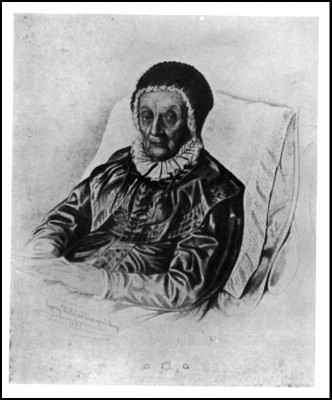
Joined by his sister in Bath, both Herschel’s were professional astronomers in the pay of the King, making Caroline the first ever professional female astronomer (he on £200pa, she as ‘assistant’ on £50pa).

Between them they discovered 3000 galaxies, and Caroline alone identified 8 comets.  Uranus was mistakenly declared a comet on its discovery in 1781.  Impressively, the Herschel star charts were still in practical use into the 1950s and 60s.

catherine_herschel
Caroline Herschel

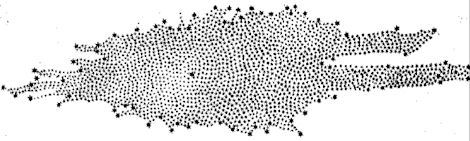
The Herschel’s were amongst the first astronomers to take an interest in the structure and evolution of the universe, rather than following the more practical motivations of the time – like enabling better navigation at sea.  William tried to measure stellar distance by the parallax method, but failed due to equipment sensitivity.  He was more successful at plotting out the shape of our galaxy – the Milky Way.

Herschel's plot of our galaxy (image WikiCommons)

William Herschel is in some ways the father of infra-red astronomy, having discovered the infra-red region of the spectrum from its warming effect on bottles of liquid; he called them ‘calorific rays’.   As Lemonick pointed out, there seems some injustice in the naming of the James Webb space telescope due to launch in 2013, which will work predominantly in the IR spectral range (there is  a William Herschel telescope already on the Canary Islands) .

And lastly – I never knew this.   It was the common belief of the time, shared by Herschel, that all the planets were inhabited, with the sun just another planet – albeit a particularly bright golden one.

The logic extended to a belief that the luminescent surface of the sun was the visible top side of clouds and, charmingly, that sunspots were holes in the cloud through which – presumably with a powerful enough telescope – one could view ‘sun people’.    Those were the days…..

Faces

Richard Wiseman has just blogged on how some people see faces in inanimate objects.  Check out the blog here, but first, what about this.

Make my Day
Make my Day

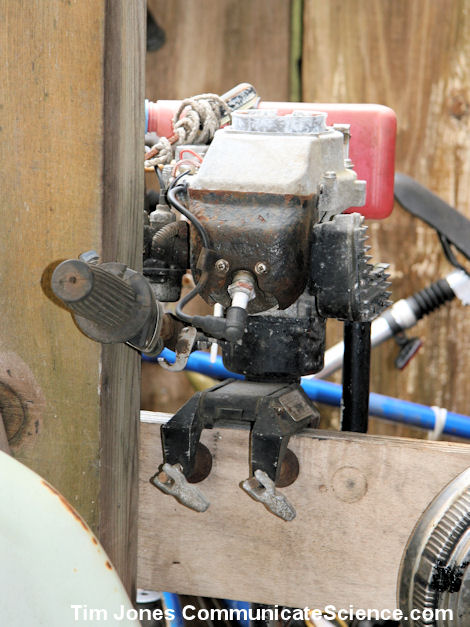
Richard would explain this in terms of psychology and interpretation.  But it’s clear this gate guardian of my (then) fiances’s flat in San Francisco is keen-eyed, shod, armed – and DANGEROUS.

Life, Talk To Me About Life

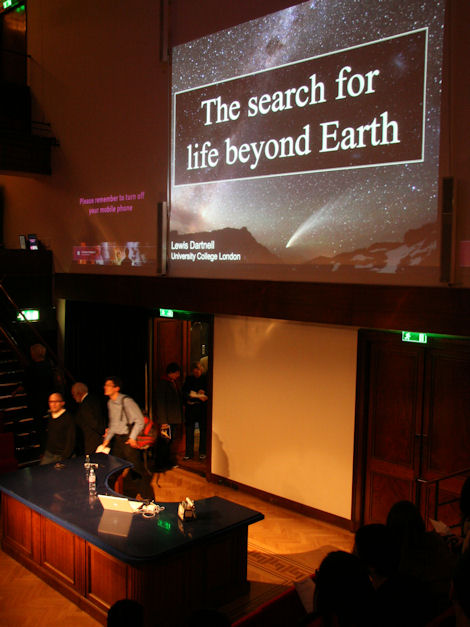
Search for Life at the Royal Institution
Search for Life at the Royal Institution (Photo Tim Jones)

I kind of expect to see demonstrations at the Royal Institution, an association with the Christmas Lectures I guess.

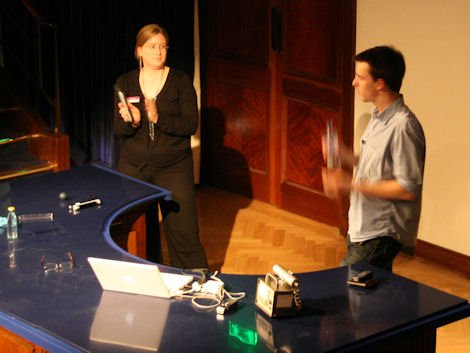
So it was nice to see a few props at Lewis Dartnell’s talk on astro-biology yesterday evening:  a Geiger counter, a jar of fluorescent quinine, a piece of Mars.   A piece of Mars !!! That got a reaction from the audience – along with an intelligent question – “how do you know it’s from Mars?”  As it happens, matching isotopes between the 1911 meteorite sample and material tested in-situ by the Viking lander on Mars leave little doubt about its origins.  Whether it contains signs of former Martian life, as some claim, is another matter.

Lewis Dartnell & Naomi Temple (Royal Institution) with the famous RI bench.  Photo: Tim Jones
Lewis Dartnell & Naomi Temple (Royal Institution) with the famous RI bench. (Photo Tim Jones)

The evening’s bottom line was that no extra-terrestrial life has yet been found; but there is particular hope for Mars and/or Jupiter’s moon Europa.

Dartnell structured his lecture from the Earth outwards: Earth, solar system, galaxy, etc.   With ‘Earth’ came a definition of life, and what an excuse that was to show some clips from this amazing Harvard Biovisions simulation of how a cell works; fast forward to 4:00mins for the best bit with vesicles being dragged along by ‘motor proteins’.

Moving out from the Earth, we find that the combination of salinity, pH, and temperature on which earth’s more ‘extremophile’ lifeforms thrive: thermophiles, acidophiles, psycrophiles in the lingo, are the exact same as those prevailing on Venus, Mars, and Jupiter’s moons.  Further out in the galaxy, there are candidate stars with Jupiter-sized planets at the right sort of solar distance for Earth-like temperature conditions to exist at their supposed moons (HD28185 and Gliese581 were the examples given).  So there’s hope.  Information, metabolism, blueprint  = Life.

Dartnell could see Martian material being brought back to earth for analysis at some point, but not for another ten years or so.  In the meantime, the European ExoMars probe, due for launch in 2011, will drive around the surface, drilling holes and taking samples.  It will also illuminate the landscape with ultraviolet light, organic molecules betraying themselves with their fluorescence.

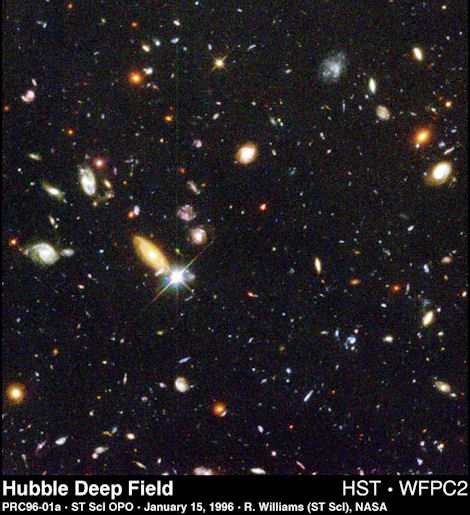
No discussion on extra-terrestrial life is complete without some sort of Saganish ‘Billions’ illustration of how many stars – and presumably planets – there are in the universe: the implication being that we have a large sample size even if the odds are thin (which they aren’t necessarily).   Lewis Dartnell showed it last night.  Astronomer Stephen Warren showed it at his inaugural lecture at Imperial College tonight.  This is the now iconic Hubble deep field image showing a section of sky equivalent to only 1/30th the moon’s diameter (Warren reckoned a 1mm square at the end of your arm – sounds about right).  And most of the objects  here are galaxies.

Hubble Deep Field
Hubble Deep Field

The insufficiently humbled can check out higher resolution versions at Hubblesite.org.

“Space is big. Really big. You just won’t believe how vastly hugely mind-bogglingly big it is. I mean, you may think it’s a long way down the road to the chemist, but that’s just peanuts to space.”

“Life, don’t talk to me about life….”

🙂

Postscript

As a quick aside.  Before Lewis Dartnell kicked off, the organisers called for a show of hands of any first time visitors to the Royal Institution, and that turned out to be a fair chunk of audience; less than 50% I reckon, but a good number.  With my SciCom hat on, that’s really encouraging – folk taking an interest in science and technology (and they didn’t look like the UFO squad either).

Buon Compleanno Galileo – “Eppur si muove”

“And yet it moves” – supposedly the rider Galileo Galilei added to his confession to the Inquisition when questioned about the earth’s movement around the sun.

And clock hands move too – across timezones.  That makes it comfortably still 15th February in my equal most favouritistical country, the USA –  so,  HAPPY BIRTHDAY GALILEO!

To tell you all about him:  heeeeeeeere’s Carl…..

Darwin’s Sacred Cause

As any Darwin aficionado will tell you, as this celebratory week draws to a close, there is one biography of Charles Darwin that stands out from the crowd.

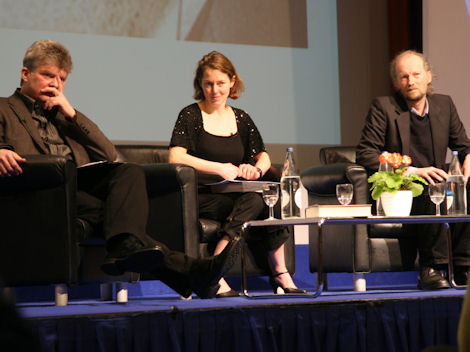
James Moore, Olivia Judson, and Adrian Desmond at Imperial College
James Moore, Olivia Judson, and Adrian Desmond at Imperial College (photo Tim Jones, Darkroommatter.com)
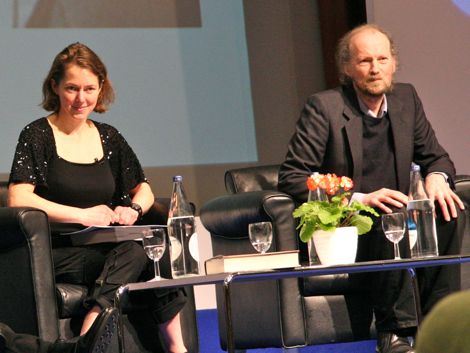
Olivia Judson and Adrian Desmond at Imperial College (photo Tim Jones)
Olivia Judson and Adrian Desmond at Imperial College (photo Tim Jones, Darkroommatter.com)
James Moore & Olivia Judson at Imperial College (photo Tim Jones)
James Moore & Olivia Judson at Imperial College (photo Tim Jones, Darkroommatter.com)

Not only is Adrian Desmond’s and James Moore’s 1991 ‘Darwin‘ comprehensive at 677 pages before the notes, it’s brick-like iconicity somehow speaks of closure, the last word, to any further debate about Darwin.

On a personal note, not withstanding Janet Browne’s Voyaging and Power of Place, which are both excellent reads, and show that Darwin was not in fact the last word, I have a particular affection for the Desmond and Moore biography.   It’s simply one of the few books of  length that I’ve ever  found the right combination of time and inclination to read right through non-stop; it took about a week one Christmas holiday.  And as with all good biographies of departed figures, that level of immersion leaves one genuinely saddened when the subject dies.

Adrian Desmond talks about Darwin's Sacred Cause (photo Tim Jones)
Adrian Desmond talks about Darwin's Sacred Cause (photo Tim Jones, Darkroommatter.com)

So it was with some interest last Monday, that I walked the whole 100 feet  or so from my department at Imperial College to the Great Hall, to join a public conversation with Olivia Judson interviewing Adrian Desmond and James Moore.  The theme –  the authors’  NEW book, ‘Darwin’s Sacred Cause‘.

James Moore
James Moore (photo: Tim Jones, Darkroommatter.com)

This post isn’t a book review.  As much as I’d like to drop everything else and read it – I haven’t found the time yet!   Thankfully, it looks nothing in length like (as Desmond reminded us at this session) ‘the brick’.

Olivia Judson
Olivia Judson (photo: Tim Jones, Darkroommatter.com)

Rather – before it becomes completely old news, I’ll point you to this online lecture podcast from Imperial College that helpfully captures the whole session.

That said, as a brief preview, the focus of the conversation is around Darwin and race, and the argument that man (as opposed to finches and other animals) was the core motivation behind developments in the theory of natural selection and the writing of the Origin of Species.  The Origin itself, we are told, was originally conceived to include extensive discussion on man and race.  The authors further link Darwin’s feelings about race back to a family upbringing and tradition steeped in benevolence and an active opposition to slavery.

Enough said for now – maybe more when I’ve read the book!

RELATED POSTS ON THIS BLOG

The Other Darwin Genius

“Very Little Can Stop The Train” Sir David King On Media Reporting and MMR

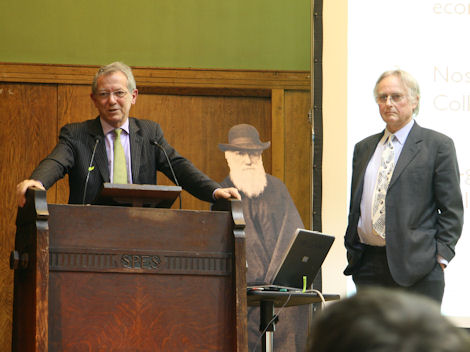
I’ve just returned from the annual British Humanist Association Darwin Day Lecture, this year delivered by Sir David King at a session chaired by Richard Dawkins.

Sir David King and Professor Richard Dawkins at the BHA Darwin Day Lecture 2009 (photo Tim Jones)

King is a former Chief Scientific Advisor to the UK Government, and now heads up a multi-disciplinary organisation tackling climate change – The Smith School of Enterprise and the Environment- at Oxford University.

His talk entitled  ‘Can British Science Rise to the New Challenges of the Twenty First Century?’ was very similar in content to one I watched him give at a PAWS event in November, and dealt less with British Science, and more with the complexities of tackling global climate change.   There were some new angles, but I’d refer you to my previous blog HERE – inspired by Sir David’s earlier talk – rather than repeat myself.   I believe a podcast of tonight’s event will appear on the BHA site in due course.

So perhaps, given the greater relevance to current debate over poor media reporting of science, and particularly that related to MMR (and the Goldacre/LBC radio encounter), you’d like to hear what Sir David volunteered tonight on that subject.  It came up in response to a question from the floor about the Daily Mail.  Sir David’s transposed response:

We’ve now got a measles epidemic growing in this country, and the measles epidemic is the result directly of a very poor piece of science from John Wakefield, somehow being published in the Lancet – should never have been published – the database was far too small.  And then gaining momentum in the media, and it’s not only the Daily Mail, John Humphreys was one of those pushing that… that the connection between MMR and autism raised real questions, and the take-up of the MMR vaccine began to fall very dramatically.  And my prediction a few years ago was that we would approach something like a hundred deaths a year from, amongst children, from measles as a measles outbreak occured, inevitably.

If you do models and you drop below 80% uptake of the vaccine, the measles must come back.  Of course the Daily Mail’s campaign was one of the instruments that got people very worried about that particular issue.  So I think that was an example where the science was so clear.  Let me tell you.  There was a Danish study of all the children born in Denmark over ten years of whom 15% had not had the MMR vaccine, and 85% had.  The statistical incidence of autism in the two groups was the same.   Now just to be on the…on the…..when I say the same within statistical error.  The nice thing was, from the point of view of those who were sceptics, that amongst the group who didn’t have the vaccine, there was a slight larger number- larger percentage – with autism.  Now any parent worrying about the situation, just needs surely to be given that set of statistics, and yet the Daily Mail wouldn’t publish it when I went to them.   What am I saying, [finding his words]well, it rarely gets their story right.  There is…there is a sort of disbelief, but I’m afraid when a newspaper is running a campaign, there’s very little can stop the train

To which Richard Dawkins, with a look of amazement and with apparent reference to the Daily Mail not printing the Denmark evidence, said – “I’m shocked


Secularist Of The Year

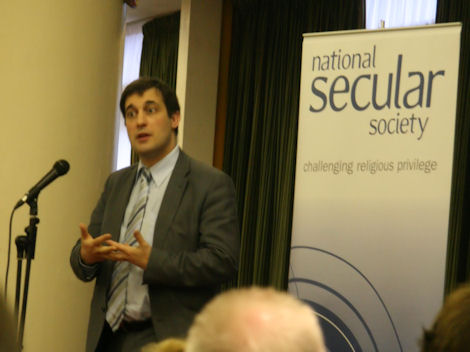
The National Secular Society’s annual award for Secularist of the Year has been awarded jointly to Dr Evan Harris MP and Lord Avebury, for their success in getting blasphemy laws abolished.  I joined the event this afternoon, which was also a celebration of Charles Darwin’s 200th anniversary, at the Imperial Hotel in central London.

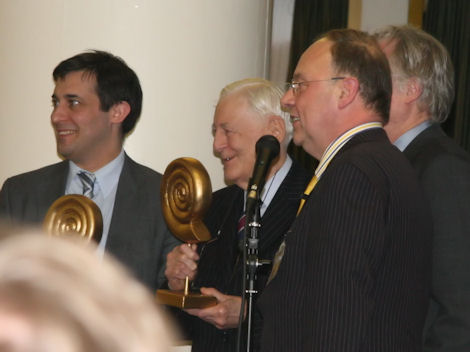
Dr Evan Harris MP and  Lord Avebury, with Executive Director NSS Keith Porteous Wood
Dr Evan Harris MP and Lord Avebury, with Executive Director NSS Keith Porteous Wood and Richard Dawkins. (Photo Tim Jones)

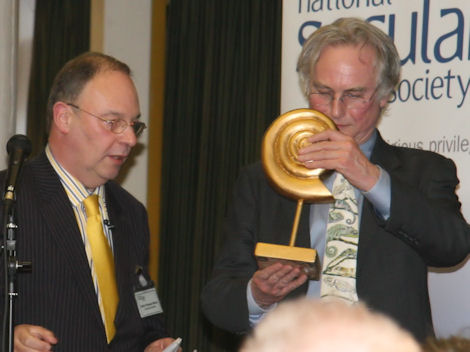
The awards were made by Professor Richard Dawkins, and comprised a golden ammonite trophy and a cheque for £5000.  Both winners declined to keep the money and donated it instead for next year’s prize.

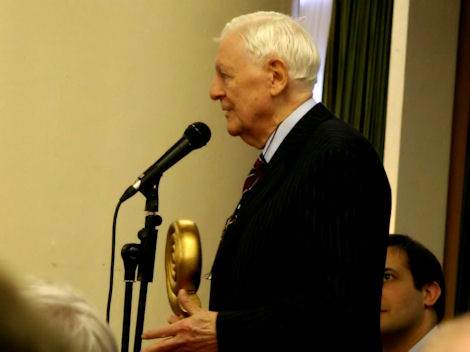
Richard Dawkins inspects a 'golden ammonite' trophy before presenting it
Richard Dawkins inspects a 'golden ammonite' trophy as Keith Porteous-Wood looks on. (Photo Tim Jones)

A range of politicians, scientists, celebrities, and commentators of various types were in the audience: including from the scientific community Prof.Peter Atkins.  Prof.Steve Jones, a previous year’s winner of the prize, sent best wishes.  Science journalists included Simon Singh (Fermat’s Last Theorem), and Ben Goldacre (Bad Science).   I also spotted former news presenter Anna Ford, and comedian Robin Ince.

Face in the crowd - Professor Peter Atkins
Face in the crowd - Professor Peter Atkins. (Photo Tim Jones)

The abolition of the blasphemy law in 2008 was something of a coup for the NSS.   Secularists have been fighting for years what has seemed like an unwinnable battle, and I sense the movement still can’t quite believe its success.  While not used since the 1970s, Christian evangelicals had been pushing for a revival in the application of the law.

Lord Averbury with trophy
Lord Averbury with trophy (Photo Tim Jones)

A statement on the NSS website after the event said: ‘The ancient law was called the common law offence of blasphemous libel, and was widely thought to be incompatible with the European Convention on Human Rights. Despite this, the Government had not been keen to abolish it, we believe because of fear of discomforting the Established Church. They see abolition as an attack on their privileged position and a possible first step towards disestablishment.’

Dr Evan Harris MP
Dr Evan Harris MP (Photo Tim Jones)

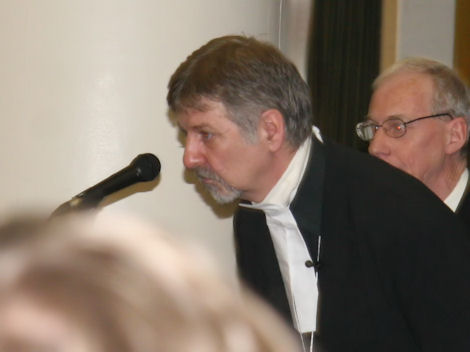
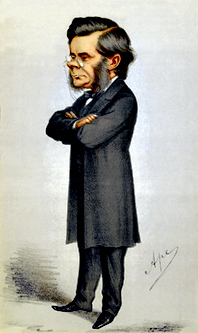
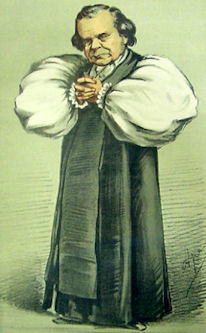
It was a lively afternoon, where the company, food, and entertainment were all excellent.   The formal entertainment took the form of a re-enactment of a debate held in Oxford in 1860 between Thomas Huxley (Darwin’s Bulldog) and the Bishop of Oxford, Samuel Wilberforce (Soapy Sam).   In ultimate irony, Wilberforce was (a little too convincingly) played by Terry Sanderson, the President of the NSS.  Given the audience, the winner of the debate was never at issue.

Terry Sanderson - convincing portrayal of Bishop Wilberforce
NSS President, Terry Sanderson - convincing portrayal of Bishop Wilberforce (Photo Tim Jones)
Thomas Huxley - 'Darwin's Bulldog'
wilberforcevanityfair1
Bishop 'Soapy' Samuel Wilberforce

Joint winner Lord Avebury’s story is equally ironic.  His grandfather, one of Darwin’s great supporters and a member of the ‘X Club‘ with Huxley, was not actually an atheist: he was too ‘conventional’, Avebury said.   Indeed, incongruous with his grandson’s award today, his grandfather had been instrumental in having Darwin buried in Westminster Abbey.

Evan Harris, who one critic has described as humourless, was everything but, quipping in surprise as he received his golden ammonite trophy: “I was always taught at Hebrew School that the Ammonites were slain by the Israelites”.

Back Pocket Big Picture

(This article originally appeared at conservationtoday.org)

Over Christmas, according to the Carbon Neutral Company’s online calculator, my wife and I were responsible for the release of 4.2 tonnes of CO2 into the atmosphere – our share of a 19000km round trip flight from London to Los Angeles.   With two such flights a year, that makes our individual emission 4.2 tonnes, or nearly half the UK per person annual average of  9.51 tonnes.
conserve

To reel off excuses for this travel (my better half hails from the US, and we like to see the in-laws in the flesh occasionally) is to miss the point, which is that I, and many more like me, at least now have some awareness and quantification of the impact we’re making; our consciousness has been raised.

We’re all part of the problem, each with our own circumstances,  and each needing a plan to address our impact.   My plan might involve paying the Carbon Neutral Company’s recommended carbon off-set fee of £35.70 in support of a Chinese hydro-electric project.  It won’t on this occasion, because while I support off-setting as one tool in the bag of control measures,  I’ve chosen instead to donate to projects benefiting animals already affected by the complex interplay of climate factors – which I’m about to come on to.

Starting the year with a  knowledge of your personal carbon footprint is only part of the story.  While sufficient perhaps for the average citizen to act upon and make a difference, policy makers, industry leaders, NGOs, conservationists, educators, and the plethora of other stakeholders and interest groups directly involved in climate change issues, need the bigger picture.

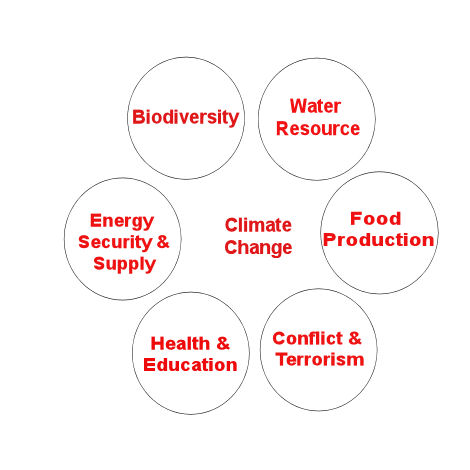
This is the bigger picture I’ll be working to in 2009, and it comes from the UK Government’s former Chief Scientific Advisor – Sir David King.   It’s been in my head, sparking ideas and resonating with a whole range of experience since I scribbled it on the back of a business card back in November.   I saw Sir David at an environmental media awards evening organised by PAWS, where he used the diagram to illustrate the important challenges of the 21st Century, and their inter-dependency.

Examples of specific  inter-dependencies are well represented in Conservation Today articles: from unpredictable climate induced pathogen interactions impacting biodiversity, to corporate actions influencing food production, to how health and education are changing the global population dynamic.   King’s representation is helpful in encapsulating the whole smash; its something you can carry around in your mental back pocket.   Away from specifics,  it also for me informs at least three more oblique, but no less important, themes that I’ll now expand upon:

  • The importance of  not generalising
  • The imperative for interdisciplinary and international cooperation
  • An opportunity for business and an alternative to rampant consumerism?

Don’t Generalise

I’ll illustrate how generalisations are dangerous with reference to two processes: desalination and GM crop growing.

Desalination is a process that has been criticised for its energy intensity and associated CO2 footprint.  King referred to the Australian province of Victoria’s response to seven years of drought conditions, whereby a third of its water will in future come from new desalination capacity.  Ultimately powered by Australia’s plentiful coal reserves, the plants will indirectly yield CO2, which will warm the planet, which will intensify the drought, which will demand more desalination plants.   It’s a simplified picture – but you get the point; in this case technology is a short term fix to a  grim spiral.

I’ve since though found a more positive example of ‘Green Desalination’ in the form of California’s Carlsbad Project.  Here, a 50 million gallon per day desalination plant is being built to supply up to 8% of San Diego County’s water needs, involving co-location of the plant with a new power station at the coast.   The encouraging  part is that when completed in 2011, it promises to be the first US plant to have a net zero carbon footprint.

So why can the Americans do it but not the Australians?    First off – don’t generalise – every situation is different; processes and power stations are not inherently evil.  San Diego County currently imports 90 percent of its water from a distance of more than 800km, from Sacramento Bay Delta and Colorado River, and the electricity needed to deliver and treat that water is close to what the new plant will use.   The mitigation of the remaining ‘CO2 gap’ will be achieved at the site through initiatives like green building design; on-site solar power generation; funding renewables; and acquisition of renewable energy credits.  Further carbon dioxide will be sequestrated by creation of coastal wetlands and reforestation (we know how important those are, see here) – and that will impact biodiversity.  See how our diagram is working here?

We also generalise when we impose the luxury of our western standards on to less wealthy societies.  Increased desertification and flooding in some Asian regions is combining with a healthier, more educated, and therefore at least temporarily increasing, population, to demand that rice farming become more intensive.  This means farming on land that may flood, requiring flood resistant rice strains – which are readily available as GM seeds.  In practice though, farmers wishing to export product beyond their own needs refrain from using GM rice because of the negative attitude it attracts in the west.  As a result, such farms may fail to meet even local food needs.  Given my personal stance on GM crops, that amounts to a case of  “one man’s lifestyle choice is another man’s starvation”.

The imperative for interdisciplinary and international cooperation

Inter-relating challenges demand an increased coordination of the political, infrastructure, research, and educational aspects associated with each.   Global warming is possibly the defining example of a need for innovatory thinking combined with an imperative for pan-disciplinary co-operation; not only across the sciences, but involving engineering, medicine, commercial, and policy elements.   The slow progress made at recent climate summits suggests the required international policy infrastructure just does not exist.  So where are the rays of hope?   The world has high hopes of Obama, and his promised global energy forum could be part of a more mature future; remember this:

“In addition I will create a Global Energy Forum—based on the G8+5, which includes all G-8 members plus Brazil, China, India, Mexico and South Africa—comprising the largest energy consuming nations from both the developed and developing world. This forum would focus exclusively on global energy and environmental issues. I will also create a Technology Transfer Program dedicated to exporting climate-friendly technologies, including green buildings, clean coal and advanced automobiles, to developing countries to help them combat climate change”

And closer to home, encouraging exemplar organisations have emerged, such as the  University College London’s Environment Institute, who are developing a pan-disciplinary approach to global warming; and King’s own organisation, the Smith School of Enterprise and the Environment in Oxford, which aims to help governments, companies, and individuals meet future environmental challenges in the context of the bigger picture.

An opportunity for business and an alternative to rampant consumption

I could easily have overprinted the big picture interactions diagram with a giant $ sign, given that all our challenges are inescapably embedded in an economic and political web of capitalist growth imperative, feeding on consumption and wealth generation.     Question is – has that web, via the present financial crisis and to a background of increased environmental awareness, had a wake up call in any positive sense?

I’m going to stick my neck out and take an upbeat, even optimistic, tack on how business and the capitalist monster can become our greatest assest in tackling the century’s environmental challenges.   How come?   Because I believe there will be a significant shift of attitudes in (a) business awareness of the opportunities from environment related projects (like the Carlsbad desalination scheme), (b) increased government investment in such projects, both as a way of countering recession and addressing the underlying environmental need, (c) a less predictable re-think on the part of private individuals about the role of consumption – particularly excessive consumption in the west –  on their well-being.   I’m most optimistic about (a) and (b), precisely because the required technologies and management practices are at present so underdeveloped.   I’m less sure about the form of, or optimistic about how we might achieve, the revised international infrastructure needed to moderate individual nation’s interests.
Charles Schmarles

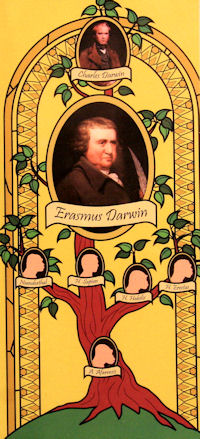
The Other Darwin Genius - Erasmus (artwork Graham Paterson)

Charles Darwin was a great guy and a credit to the species.  But in this centenary year, he’s getting more than enough coverage already.

Erasmus Darwin, Charles’s grandfather, was the REAL  deal.

View or download my new illustrated article about Erasmus in iScience magazine:

Download pdf HERE (right click then ‘save as’)

then show everyone how ahead of the evolutionary curve you are with this ‘Other Darwin Genius’ tee-shirt, exclusive to Zoonomian at CommunicateScience.  100% American made and shipped to you direct from RedBubble.  Just click the ‘View & Buy’ link below.