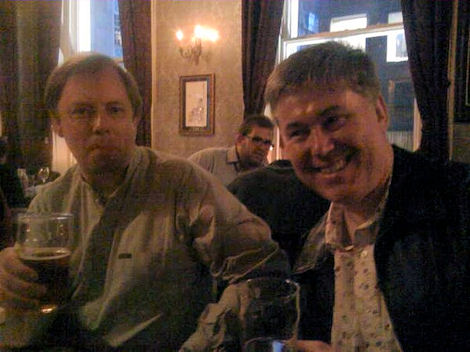
Friday 15th May saw the first get together of the UK Science Tweeps, that allowed a group of individuals who had previously met only via Twitter to share a drink in person. Karen James organised the evening, pulling us together under the Twitter tag #ukscitweetup. So now you can meet some of the science tweeps for yourself and get a flavour of the evening. And, if you like what you hear, join us next time!
Tim Jones (@physicus) and Tim Harper (@tim_harper)
Short note on my ‘Darwin Hat-Trick day’ last Wednesday. Nothing too profound – but some nice pics!
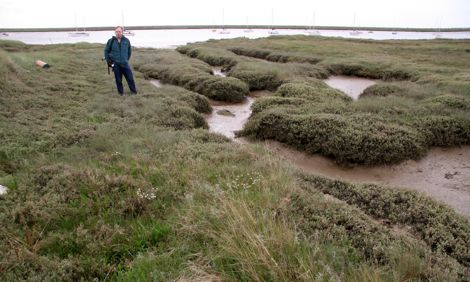
Final resting place of the Beagle? Cutting in the Paglesham shore (photo Tim Jones)
And again with me for scale (photo: Sven Klinge)
We set off at 5 a.m., and by the end of the day had visited: (a) the supposed final resting place of Darwin’s Beagle at Paglesham, (b)the newly refurbished former home of Darwin, ‘Down House’, in Kent, (c) the Geological Society in central London for a talk from Darwin biographer Janet Browne.
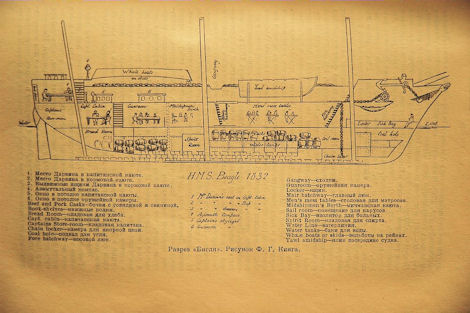
The Beagle (image Wikimedia Commons)
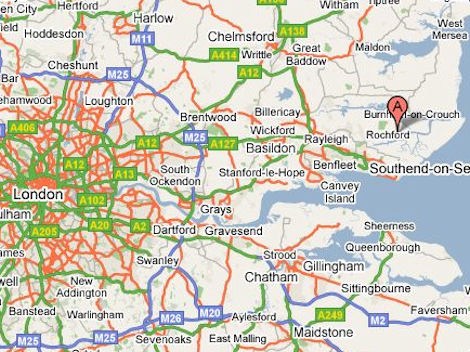
Paglesham location Nr. Rochford (image Google Maps)
This sudden urge to drive around some of the more remote reaches of England’s green and pleasant land was triggered by a recent talk by Dr Robert Prescott at the Royal Society. A podcast or vidcast should be available here within the next few days.
Prescott, who is researching the Beagle’s fate post-Darwin, has shown that after her last sea voyage in 1843 the ship served as an anti-smuggling watch vessel, anchored amidst the twisting system of waterways north of the Thames estuary. He speculates, with evidence from contemporary charts, that the mastless hulk ended its days in a permanent mooring cut into the mud of Paglesham East End, near Rochford. With images from Prescott’s talks fresh in our minds, we successfully located the otherwise unremarkable stretch of grassy mud-bank shown in the first photo.
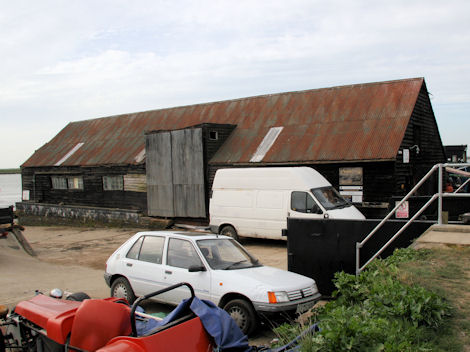
Ground radar has revealed something of the right size and shape for the Beagle about 6 meters down, but tests on core drill samples are ongoing. The team have identified wood and diatoms, and now hope to find evidence of life specific to the South Seas caught up in the timbers. There’s some evidence that the top half of the ship was salvaged, and wooden structures consistent with the naval architecture of the day have been found in this nearby boathouse.
Timber structures consistent with the Beagle were found in this building (photo Tim Jones)
According to Prescott, Darwin never visited the Beagle after his famous voyage, despite the relative proximity of the craft to his home at Downe and documentary evidence that the Beagle’s Captain – Fitzroy – had kept in contact with Darwin. While Darwin acknowledged the importance of the ship to his life and work, it appears any emotional attachment he had for the vessel did not extend to a need to be reunited.
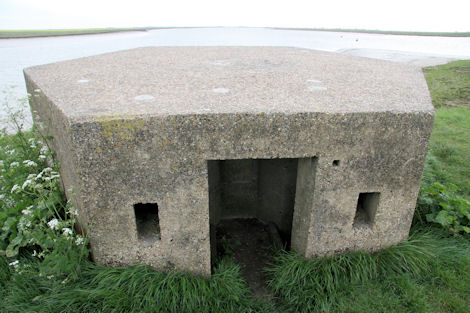
Having driven 60 miles to walk over a (albeit important) stretch of mud, we continued our walk along the river bank to be rewarded with a watch post from another era – a World War II pillbox. Pillboxes like these can be found across the south of England, and originally formed a continuous defensive line against potential German invasion.
World War II defensive pillbox at Paglesham (photo Tim Jones)
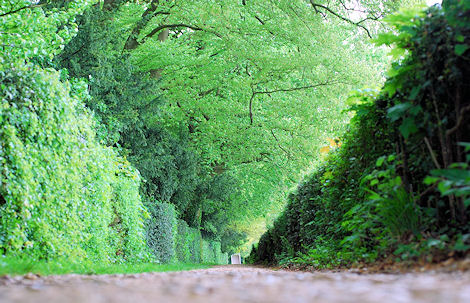
Leaving Paglesham around 9 a.m., and arriving at Down House half an hour before the house itself opened, gave us plenty of time to explore the grounds and gardens of the Darwin family home. There’s been some replanting and landscaping as part of the refurbishment, but the famous greenhouse and ‘sandwalk’ , where Darwin did some of his most inspired thinking, are rightly unchanged.
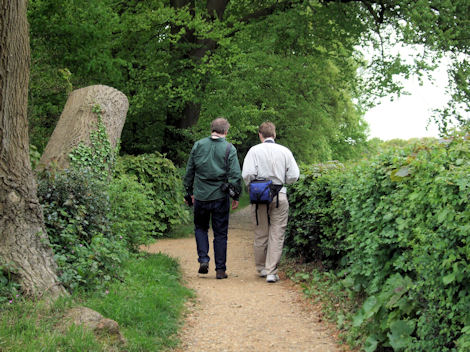
Learned Gentlemen look for inspiration on the 'Sandwalk' (photo Belinda Murphy)
Interesting angle on the sandwalk (photo Sven Klinge)
The house itself has benefited from a super exterior paint job and refurbishment, and a major re-modeling of the upper-floor exhibition space. The personal audio guides are now video guides, but retain a pleasant enough welcome from David Attenborough. But, photographers beware ! I’ve never been anywhere where the taking of pictures inside the house is so actively discouraged – quite a contrast to how things are managed in the USA. I’d also advise an early weekday visit, as parking is limited and the experience degrades when the house is crowded. All the same, it’s a beautiful location, the house is full of atmosphere, and it’s well worth the £8 entrance fee.
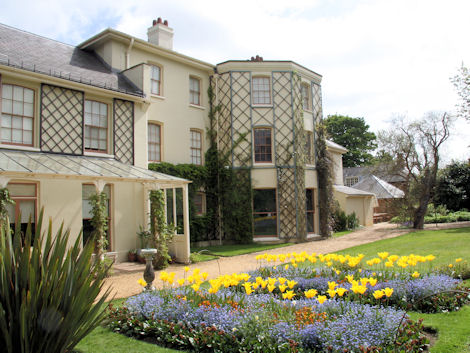
Down House - rear from the garden (photo Tim Jones)
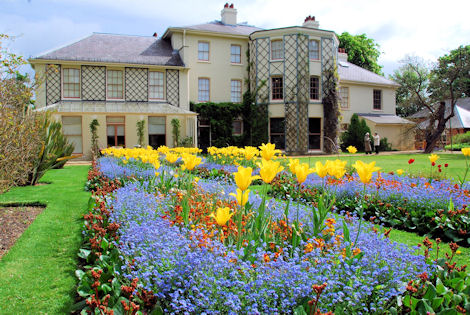
Down House rear garden (phot Sven Klinge)
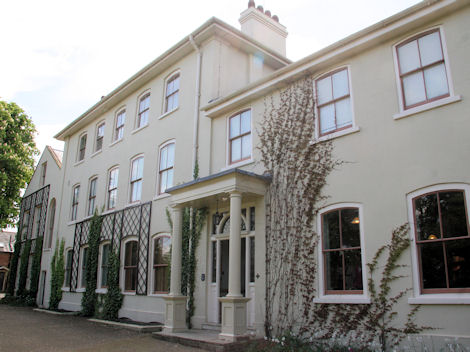
Down House frontage (photo Tim Jones)
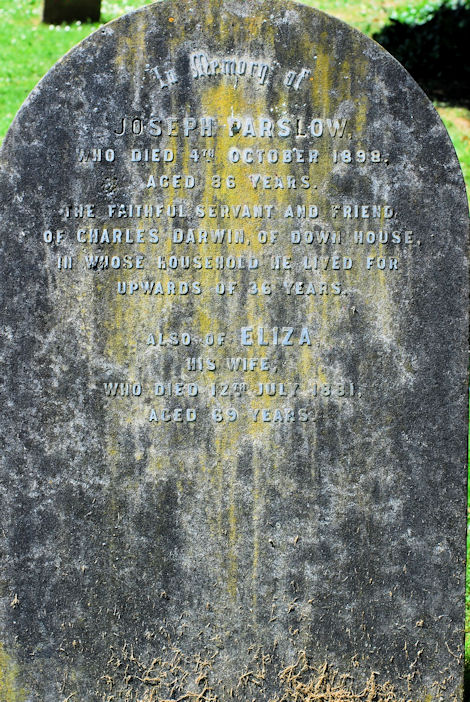
Down House is a stone’s throw from the village of Downe (with an ‘e’ this time) and the local church where Emma Darwin, Charles’s brother Erasmus, and Darwin’s servant Parslow are buried.
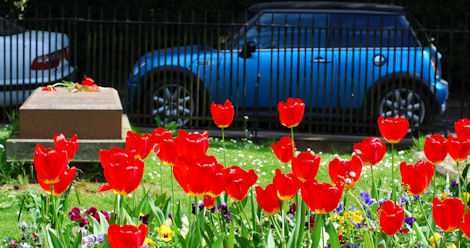
Emma and Erasmus's grave in Downe Cemetary (photo Sven Klinge)
Grave of Darwin's servant Parslow (photo Sven Klinge)
At 2 o’clock we were starting to feel the effects of the early start, so it was back to Kingston to drop off the car and consume some large coffees.
Phase three of our hat-trick required a train ride into the centre of London to see and hear Janet Browne speak at the Geological Society.
Janet Browne at the Royal Geological Society (photo Sven Klinge)
Browne, best known for her two Darwin biographies Voyaging and Power of Place, was over from Harvard to speak on the theme of ‘Two Hundred Years of Evolution: Celebrating Charles Darwin in 2009’ .
I guess the thrust of the talk was around how the various controversies surrounding Darwin and his theory have been accepted, challenged, and interpreted at different times and places. For my part I found Browne’s historical interpretation clear and entertaining. I was, however, at something of a loss to understand quite where she personally stood on more contemporary issues such as the compatibility of Darwinian evolutionary theory and religious belief. What I took from the early part of her talk as an accommodationist approach didn’t entirely jibe with her response during questions when, for example, she credited Dawkins’s stance as ‘brave’. Anyhow, you can listen to the podcast here at the Geological Society website and draw your own conclusions.
I can’t let the day go by without some sort of homage to Thomas Henry Huxley (1825-1895); for today – 4th May – is indeed his birthday.
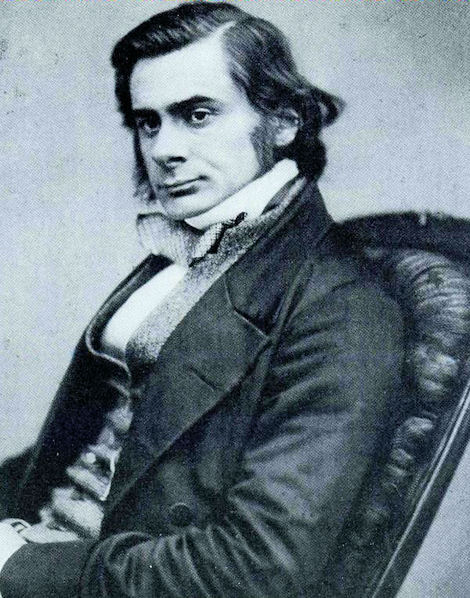
The younger Thomas Henry Huxley
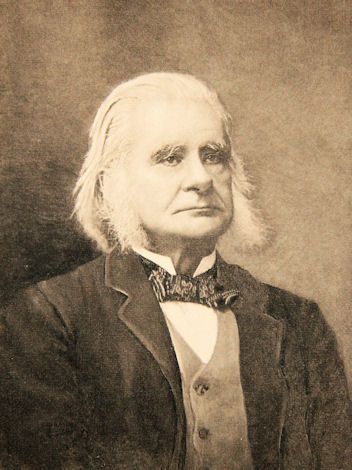
Huxley in 1893 (photo Tim Jones from a print in ‘Life & Letters’ Appleby 1901)
Everyone with a special interest in science, or those working in the sciences, has heard of T.H. Huxley. But for many others the name Huxley is more often associated with T.H.’s grandson Aldous – of ‘Brave New World’ fame or, closer to 20th century science and politics, Aldous’s biologist brother and founder of UNESCO Julian Huxley.
And in Darwin’s 200th anniversary year we’ve seen ‘T.H.’ come to the fore as Darwin’s Bulldog – portrayed as a kind of willing intellectual ‘heavy’, clearing the way of dissenters for Charles’s evolutionary thesis to hold forth – sending bishops flying as he went. I referenced the most recent re-enactment of Huxley’s encounter with Bishop Wilberforce during this year’s Secularist of the Year Awards here.
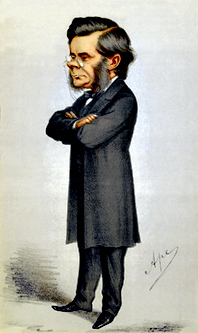
Thomas Huxley – ‘Darwin’s Bulldog’ (image Vanity Fair)
But Thomas Henry was very much his own man (no sexism intended). Originally trained in medicine, he served as a ship’s surgeon aboard the Rattlesnake in early life but, lacking the financial independence enjoyed by Darwin and other ‘gentlemen scientists’ of the day, had to establish his scientific credibility by hard clawing through the establishment.
In fact, T.H. should be the patron saint of impoverished scientists, for while his later life was comfortable, financial recompense during most of his career was totally out of kilter with his societal contribution and achievement. Fortunately, on an occasion when Huxley’s body failed to keep pace with his spirit, friends who were also members of the scientific ‘X-Club’ chipped in with Darwin to pay for a recuperative continental break.
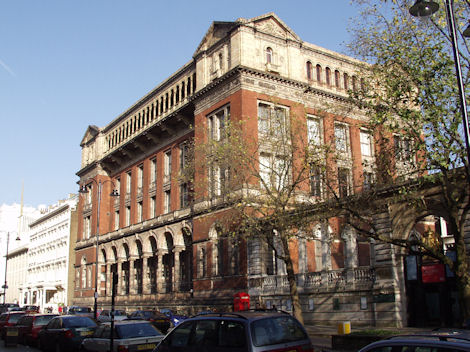
Huxley’s interest was science in all its manifestations, and his legacy is today’s acceptance of science as a profession, and a system for science education that has its roots in the biology classes he held at South Kensington.
Huxley worked on the top floor of this building in South Kensington, London (now part of the V&A museum) (photo Tim Jones)
But T.H. was not happy doing just science. In fact there was a conscious moment when he was overtaken by the conviction that helping others understand science was even more important than the science itself; I guess that makes him the patron saint of science communicators as well then!
There was nothing snobbish or ‘look down your nose’ about Huxley’s lectures for working men. His monologue on ‘A Piece of Chalk’ is an icon of communication – of any sort – and can be compared with Michael Faraday’s famed public dissection of ‘The Chemical History of A Candle’ at the Royal Institution.
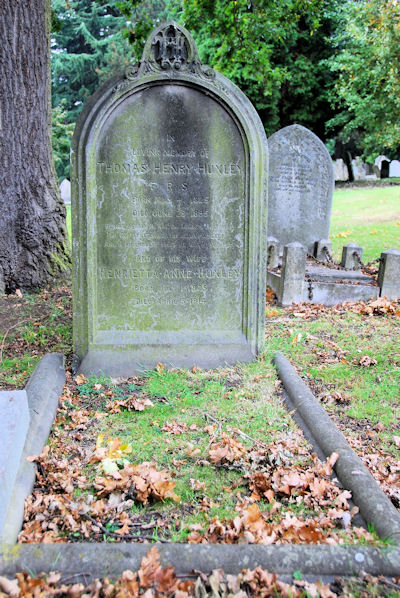
T.H.Huxley’s grave in East Finchley (photo Thanks Sven Klinge)
Being so close to nature, evolutionary concepts, and Charles Darwin, Huxley was bound to take a stance on religion. He coined the term ‘agnostic’ and declared himself as such. I think to understand exactly what HE meant by that you need to read his letters and essays. A pragmatist, Huxley did not subscribe to religious dogma through scripture, but at the same time was concerned that society could not function without something to fill the gap that would be left by, say, the removal of bibles from schools. I’ll resist several more paragraphs comparing Huxley to Richard Dawkins in this regard; suffice to say I believe there are fundamental similarities between the two – but also differences.
Although you’d never guess from the title or intro to this blog, it was Huxley, and specifically Adrian Desmond’s biographies – ‘The Devil’s Desciple’ and ‘From Devil’s Desciple to Evolution’s High Priest’ (which respectively deal with Huxley’s earlier and later years) that have most inspired me – in quite fundamental ways.
Anyone who ‘Twitters’ knows there are an awful lot of motivational gurus out there and, while I’m not against that, believe you’ll find in Huxley’s life a 90% exemplar of the right-thinking, right-stuff behaviour for a happy life. In fact, exploring the Zoonomian Archives I find I referenced the great man in August last year, here comparing his philosophy with that of a former headmaster at my school; perhaps the Huxley influence runs deeper than I know? There endeth that lesson.
If you want to know more about T.H., read the Desmond biographies alongside some of Huxley’s collected essays. And for a deeper understanding, the ‘Life and Letters of T.H.Huxley’ – published by his son Leonard in 1901 are engaging. The Huxley File is a comprehensive web reference.
Now something for the Huxley aficionados and the just plain interested:
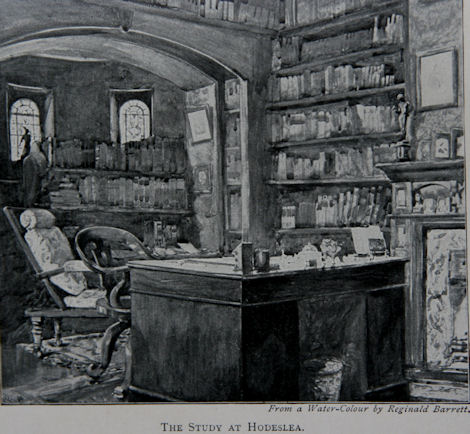
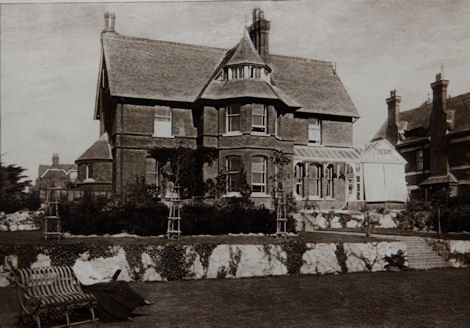
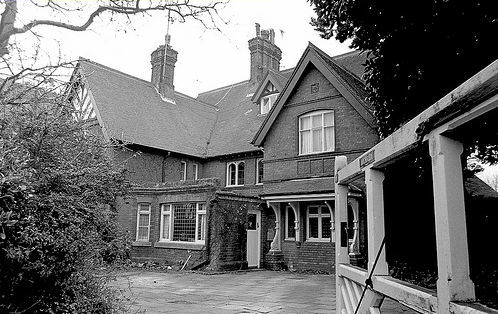
On 15th July 1893, Huxley was sitting at his desk in his home Hodeslea, in Eastborne in the south of England, writing a letter to Sir J Skelton; you can find it on p.383 of the U.S. Appleton edition of ‘Letters’.
Huxley’s study at Hodeslea. Painted 1893. (Source: Life and Letters of Thomas Henry Huxley, D.Appleton and Sons, 1901
Hodeslea in Huxley’s Day (Source: Life and Letters of Thomas Henry Huxley, D.Appleton & Sons, 1901)
Hodeslea Today (photo permission P.D.Smith)
Huxley tells Skelton how he never fully recovered from a bout of influenza in the spring and is setting off the next day to Maloja (Switzerland) for one of his recuperative breaks. As Huxley says: “It mended up the shaky old heart-pump five years ago, and I hope will again.” The next recorded letter I can find is from October 1st 1893. But Huxley did write at least one more letter on the 15th July – I know because I have it :-).
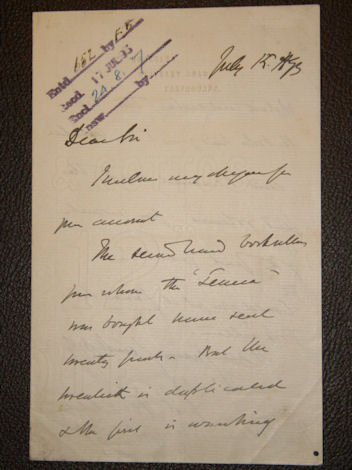
Huxley’s letter to Williams & Norgate (photo Tim Jones, Huxley ALS private ownership)
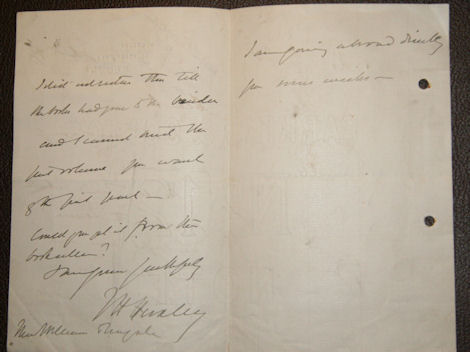
The note is to the publishers Williams and Norgate, sending a cheque as payment on his account, and asking them to obtain a missing volume.
Huxley’s letter to Williams & Norgate (photo Tim Jones, Huxley ALS private ownership)
So, it’s not exactly a keystone in the scientific chronology. But, taken in the context of the Skelton letter, Huxley’s last line does conjour up images of packed suitcases and trunks: ‘I am going abroad directly for nine weeks‘. Proving……I’m just a big romantic at heart.
This website uses cookies to improve your experience while you navigate through the website. Out of these, the cookies that are categorized as necessary are stored on your browser as they are essential for the working of basic functionalities of the website. We also use third-party cookies that help us analyze and understand how you use this website. These cookies will be stored in your browser only with your consent. You also have the option to opt-out of these cookies. But opting out of some of these cookies may affect your browsing experience.
Necessary cookies are absolutely essential for the website to function properly. This category only includes cookies that ensures basic functionalities and security features of the website. These cookies do not store any personal information.
Any cookies that may not be particularly necessary for the website to function and is used specifically to collect user personal data via analytics, ads, other embedded contents are termed as non-necessary cookies. It is mandatory to procure user consent prior to running these cookies on your website.