In this podcast I meet a team from Imperial College who are leading the field in the application of virtual worlds for medical training. The package was originally broadcast on the radio show Mission Impossible on ICradio.com on 23rd June 2009.

In this podcast I meet a team from Imperial College who are leading the field in the application of virtual worlds for medical training. The package was originally broadcast on the radio show Mission Impossible on ICradio.com on 23rd June 2009.
Life on Earth and the possibility of life beyond the stars fascinates Dr Lewis Dartnell.

I interviewed Lewis for Imperial College Radio, and this podcast is the full conversation. We cover Dartnell’s core research in Martian radiation, the recently launched Kepler telescope, possible earth asteroid strikes. Lewis describes how knowledge of conditions on other worlds might inform maintenance of the Earth.
The noisy aircon is regrettable; and as a result the sound quality is less than ideal.
Nanotechnology lets us manipulate materials at the finest scale. ‘Nanotech’ products have become mainstream without us even noticing, and the future promise for the technology is forcing nothing less than a paradigm change in mindset and expectation.

In this interview for radio, I ask Dr Andrew Maynard, Chief Science Advisor on the Project for Emerging Nanotechnologies at the Woodrow Wilson Center, for his views on current applications, far reach potential, and the risk management challenges associated with nanotechnology.
(this is a slightly longer version of the interview first broadcast on ICRadio on 16th June 2009)
Andrew Maynard blogs at 2020Science
Conservation, business, and the Olive Ridley Turtle. This article was originally published at ConservationToday.Org
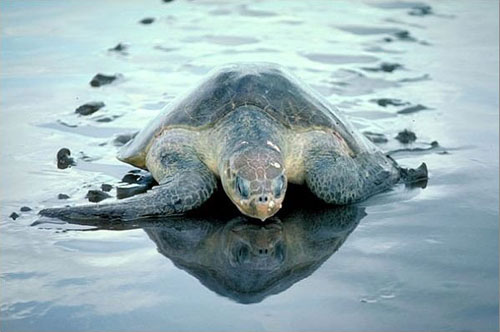
It’s almost exactly a year since I left my job as director for procurement strategy and development at Corus, the Anglo-Dutch steel business owned by India’sTata Steel Group. I have happy memories of meeting Indian colleagues in Kolkota and visiting Tata’s operations at Jamshedpur. So it’s been especially disappointing to watch over the year a progressive sickening of relations between Tata Steel, the International Union for the Conservation of Nature (IUCN), and Greenpeace, over the issue of the Olive Ridley Turtle.
Briefly, the case concerns the potential impact on the turtles beaching behaviour of the construction, by a Tata JV company, of a deep water port at Dhamra, on India’s Bengal coast. The case is complex and unresolved to the satisfaction of all parties, particularly Greenpeace, who have criticised the nature of the IUCN’s engagement with Tata. I don’t plan to dissect the case here; starting points for that can be found at these sites: IUCN press release (2008), Dhamra Port Company Statement, Greenpeace.
Rather, the case prompts reflection on the broader relationship between business and the environment – including conservation. My message is that a business-like and emotion-free relationship is requisite, and that negative criticisms (founded or not) of individual involvements by organisations like the IUCN should not distract from the essential wisdom of their philosophy for business engagement.
As Mohammed Valli Moosa, President of the IUCN has said:
“We are living in an era of global economic expansion. The private sector is a major player in this period of unprecedented development. Business has a responsibility to the global environment. Business has to do more than just avoid prosecution.”
(source: Partnerships for the Planet)
Moosa here is not showing anti-business sentiment; indeed, he questions the way the conservation movement has traditionally engaged with business, as in this report by the New York Times on the occasion of the 2008 World Conservation Congress.
Part of the IUCN’s role is to provide a forum where traditionally divergent views and stakeholders can find solutions that don’t reject the market, but work with it, and has established the Business and Biodiversity Programme (BBP) to support its goals.
The IUCN helps businesses like Shell, Holcim, and Tata to formulate best practice standards and improved conservation policies. The approach is consciously ‘pragmatic’ (IUCN’s term). Dialogue does not mean an absence of criticism; the IUCN have challenged Shell on an energy strategy that focuses on biofuels over wind and solar (link to report here). On the Dhamra project, the IUCN have in an agreement with Tata advised on the possible impact and mitigation of environmental concerns, although not to the satisfaction, particularly, of Greenpeace. References in the various chat forums around the case allude to ‘greenwashing’ and abandonment of the ‘precautionary principle’ – implying some kind of sell-out to big business.
Engagement with business and business management principles is far from a sell-out. By attaching an economic value to the social cost of environmental impact, Nicolas Stern’s report on climate change caught the attention of the political and business world like never before. Businesses are coming to realise energy efficiencies and GHG emissions reduction can be achieved profitably through technology and improved corporate housekeeping. The motivation for these actions is becoming less a response to protest and more a simple case of delivering to shareholder approved corporate plans; manifest not only in the glossy pages of corporate social responsibility or environmental reports, but embedded in the financial plans owned by company CFOs. It is in the conservationists interest as well that businesses make this mind-set internally sustainable, and should be encouraging businesses to include environmental expertise on their boards – maybe in a non-executive director capacity. Governments have a critical role in removing obfuscating sudsidies and making transparent the true costs of commodities and supply chains to businesses and private individuals.
Tension between business and conservationist goals will not reduce further until a true costing of impacts is agreed and worked to. As that develops, we must guard against the equation being muddied by subjective judgements and emotion. In the meantime, a degree of compromise is requisite on both sides, and a recognition that more can be achieved as a team, even one working under constructive tension.
Some of you may know that in addition to Zoonomian, I’m a contributing editor at ConservationToday.org, the conservation group run by post-graduate students from Imperial College under the leadership of Will Pearse.
It’s therefore a great pleasure to introduce this first one day conference organised by ConservationToday, and encourage you to go along.
The Open Ground conference will explore the common ground between the wider arts and sciences in conservation – taking place on the 20th of June in London.
John Fa – Director of conservation science at the Durrell Wildlife Conservation Trust
Armand Leroi – Professor at Imperial College London and BBC presenter of ‘Darwin’s Lost Voyage’
Sam Turvey – involved with the Yangtze River Dolphin, ZSL
Ruth Padel – former Professor of Poetry at Oxford and prize-winning author of ‘Darwin: a life in poems’
…and many more!
UPDATE Feb 2010
The audio of proceedings is here.