Aspects of the lives of famous people inevitably get magnified, diminished, distorted or simply lost with the passing years.
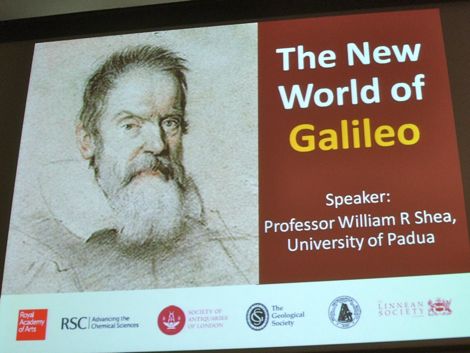
That’s why we need respected scholars with the learning and gravitas of Professor William Shea who, speaking recently at the Royal Geological Society, took us – somewhat teasingly but with due respect – beyond the accepted caricature of Galileo’s genius.
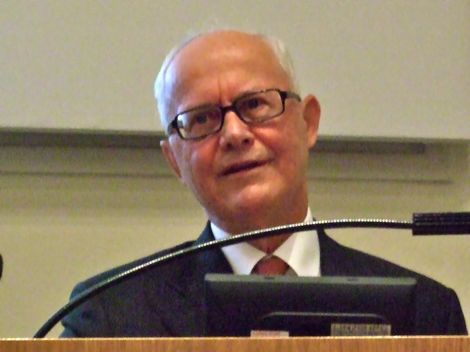
And Shea, who holds the Galileo Chair of the History of Science at the University of Padua (where Galileo himself taught for 18 years), did indeed illustrate Galileo’s discomfort with the optical theory behind his own telescope.
In the body of the talk, working through the popularly accepted seven great achievements of Galileo, Prof. Shea used a sequence of lunar drawings to illustrate the critical role of sci-art collaboration in marrying draughting skills with observational expertise – in the days before photography and Charge Coupled Devices.
In a Q&A that was as revealing as the main lecture, Shea explained how the early astronomer’s belief in the divine appointment of his scientific mission was a key driver for his intellectual ambition, as well as representing an important influence over his relationships with academic colleagues and the establishment.
Overall, this was an expertly and engagingly presented lecture which everyone with an interest in science, and for that matter art and history, should see. And they can; because the whole smash is available courtesy of the Royal Geological Society via this link to a videocast of the event , complete with slides and the candid Q&A. Check it out !