SPOILER ALERT ! – ANSWER IS NOW UP, THIRD PHOTO DOWN
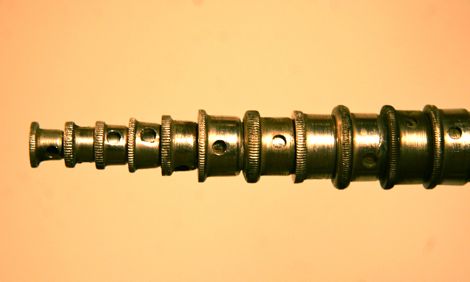
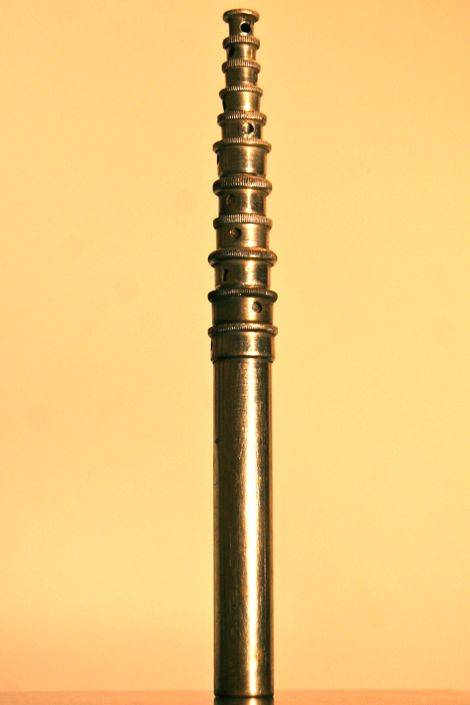
Here is the first, and very possibly last, mystery object on Zoonomian.
It is science-related, and I just found it lying around the house – which looking at the other weird stuff around here isn’t even a clue. Ideas on a postcard, twitter, or you could even leave a comment with your happy memories of this object below.
Update 27/3/10: OK – Joerg Heber, via Twitter, reckons it’s a Dalek. Wrong. Here is the whole thing then. Easy now, right?
Update 28/3/10: Responses via Twitter and e-mail: It’s not a Galilean telescope, musical instrument, gas relief valve, or navigational tool.
(If comment box doesn’t appear below, click ‘comments’ under the title)
THE ANSWER
All very confusing isn’t it. But not, in the words of S.R.Hadden, “if you think like a Vegan”…..a Vegan laboratory technician that is.
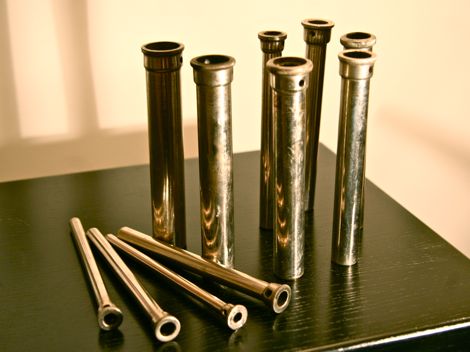
Because the mystery object, in its full unraveled glory, is a set of mid-twentieth century laboratory cork borers.
Cork borers (Photo:Tim Jones)
To better understand the lost art of laboratory cork boring, we can usefully turn to our copy of ‘How to make common things, for boys’ – by John A Bower:
“The borer is a brass tube with sharp cutting edges, as shown in [the figure], which should be carefully kept, so that the cutting part does not get turned up by coming into rough contact with your file, or by falling on a hard floor,, for the edge is soft, and only adapted to cut such soft substances as cork. Cork-borers are sold in sets (see figure). To bore the cork, put a stout wire through the hole at the upper end of the barrel of the borer; hold the cork firmly in the left hand, pressing it down on a board, or hold it flush with the edge of the board. Begin with the smaller end of the cork. Hold the borer at right angles to the top of the cork ; then with a slight pressure turn it into the cork, till you find it through the other end. Draw out the borer, and with the wire posh out the core from inside of the tube and pat it away – the borer may then be smeared over with a little petroleum to keep it bright“
Set of cork borers (From John A Bower's 'How to make common things for boys')
I ‘acquired’ my set from Birmingham University in the mid-eighties, and have used them in anger on cork and rubber no less. You can still buy similar sets, but they tend to come with handles built in – which kind of gives the game away from a mystery object perspective.
So, sorry if you were expecting a ‘flux capacitor’, or something out of the LHC. I guess the true answer is relatively boring.
Hardcover: 260 pages Publisher: Allen Lane (4 Mar 2010) ISBN-10: 1846141427 ISBN-13: 978-1846141423
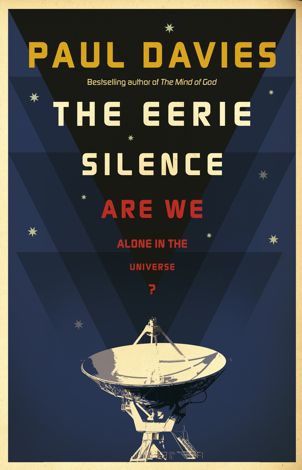
The search for extra-terrestrial intelligence, or SETI, is in a rut. That is Paul Davies’s message in ‘The Eerie Silence – Are we alone in the Universe’ – a thorough taking stock of the programme started by Frank Drake in 1959 to search for alien radio messages from outer space.
Davies wants a rethink from scratch, where we shake off the blinkers of anthropocentric thinking and question exactly what we should be looking for. Listening out for a direct radio message is fine, but lets extend the search to include more subtle evidence of alien legacy and the very origin of life.
ET has indeed been strangely quiet, and for Davies two rather extreme explanations for that are providing signposts to a ‘New SETI’.
Under the first option, we have to accept that life on Earth was born of a series of events so incredibly flukey they will never be repeated. Under the second, we face the chilling prospect that intelligent life pops up quite frequently, only to develop a propensity for technology fueled self-destruction.
Holding out hope for a middle way, and putting speculation over self-destructing aliens aside, Davies argues there is a raft of solid science we could be getting on with to better understand the scarcity of life. Those up for the task (and skilled enough to secure funding) will enter a field of polarised opinions and a paucity of hard evidence. The prize? – possibly the final word on the question of whether life is ubiquitous in the universe – a ‘cosmic imperative’ – or that you and I here on Earth are a one-off, somewhat lonesome, rarity.
We should still listen for radio messages, says Davies, enthusing over SETI’s groundbreaking Allen Telescope Array (ATA) of radio telescopes; but the emphasis should be on searching for new types of evidence of intelligence, both in space and closer to home – on Earth in fact.
If we can show life on Earth started independently more than once – a second genesis if you like – the fluke theory is destroyed and the prospect of life existing on the billion or so Earth-like planets in our galaxy increases immensely. Once life has started, there is pretty much universal agreement among scientists that Darwinian style evolution will, environmental factors willing, take over to produce complex life forms and probably intelligence and consciousness. Second (and third and fourth..) genesis life forms could be living alongside us today, unrecognised as a microbial ‘shadow biosphere’ – the holy grail for researchers now culturing candidate samples from Mono Lake in California. Or we might find tell-tale markers of an extinct second genesis in geological records that we have seen but incorrectly interpreted. With so many work areas highlighted as candidates for inclusion in New SETI, a problem for potential researchers could be deciding where to focus their application. Presumably Davies is taking calls.
Moving from Petri dish to telescope dish, Davies believes our pre-conceptions of ET in space are causing us to define too narrow a target there also. Any intelligent biological life, he says, will quickly transition to an intellectually superior machine form having nothing in common with Homo sapiens and little to gain from interstellar chit-chat.
Or the aliens may have launched beacons that ping data packets only once a year. Or they may have sent probes – monolith fashion – to lurk around our solar system, programmed to spring to life when we learn to think up to their level. The point is we will only detect this kind of activity if we specifically look for it.
In his most futuristic speculation, Davies envisions life evolving into a quantum computer – an extended network of energy floating through space, amusing itself solving complex mathematical doodles. The implication of course, if such ‘beings’ exist, is that we are headed in the exact same direction. How do you fancy being a node in a pan-galactic thought matrix?
Among other thought-provoking revelations, we learn the Earth has for billions of years been happily swapping rocks, possibly with primitive life aboard, with other planets in the solar system – including Mars. That makes the potential discovery of life on that planet important, but not necessarily a game-changer for SETI, as Martian and Earth life could share the same unique origin.
Davies puts SETI into historical context on a quirkier note, recounting how the mathematician Karl Gauss, as early as the turn of the 19th century, planned to signal the Martians using huge shapes cut out of trees in the Siberian forest.
There is an implicit appeal in The Eerie Silence for scientists from different disciplines to work together on SETI and astrobiology – maybe a guiding principle for New SETI? Astronomers, biologists, geologists, engineers, astro-physicists and cosmologists all have a role in the search – as do non-scientists.
That also holds true for the post-detection task-group Davies leads, set up to advise an appropriate response in the event ET finally calls. In a chapter devoted to the implications of ‘first contact’, he asks how various groups: from the media, through politicians, the military, and religious believers might react. If we receive a targeted message, we should certainly think carefully about the reply. But that we already send the occasional burst of blindly targeted radio messages into space is a positive in Davies’s book; at least it makes people think about science, humanity, and what in our culture we value. Religion, and particularly Christianity, Davies believes, will struggle to reconcile dogma with the existence of intelligent aliens.
In his wind-up, Davies keeps all options open as to the chances of a positive outcome for SETI. But on balance, hardcore enthusiasts of radio SETI in particular may well find the The Eerie Silence a bit of a downer. Likewise, those looking for evidence to support more philosophical ideas around nature favouring life, or the existence of a life principle buried in the physics and chemistry of the universe – themes Davies has arguably been more sympathetic to in previous works – will be disappointed as he rejects each in turn.
To its credit, The Eerie Silence is as much about human motivations and psychology as it is about research and radio antennae. A chatty narrative with frequent episodes of self-examination strikes chords with thoughts and feelings most of us will have had: like the need for a sense of self, and a yearning for meaning. The search for ET is very much the search for what we are, what we may become, and what ‘it’ all means. A cliched theme maybe, but well supported here with relevant facts and reasoned speculation. Davies’s talent for projecting rock-solid scientific rationalism while not (entirely) closing the door on other perspectives has produced an absorbing read.
Other posts related to astrobiology and SETI on Zoonmian
In February, I told you in this post about a competition sponsored by publishers Penguin UK together with National Science and Engineering Week, that asked YOU to suggest a message we might beam into space at the aliens. The idea stemmed from Paul Davies’s new book ‘The Eerie Silence’ .
Paul Davies
It turns out that nearly 1000 messages received from all over the world are, as of 2pm 12th March, winging their way across the cosmos in the direction of the Orion nebula, courtesy of BT’s Goonhilly Earth Station in Cornwall. This was the first day of National Science and Engineering Week UK, and included The Big Bang event at Manchester Central Conference Centre. Joining the event, astrophysicist author Davies said:
“From time to time, humans have deliberately beamed powerful messages into space to attract the attention of any cosmic company. On Friday, a big radio dish in Cornwall will do just that, conveying a selection of messages from earthlings to anyone who cares to listen. The messages will be directed towards the Orion nebula, a stellar nursery that would be an attractive location for an advanced alien community with astro-engineering prowess. It will take over 1,200 years for the messages to arrive, travelling at the speed of light, and I for one won’t be around to receive any reply. But the purpose of the exercise is not so much to establish a dialogue with ET. Rather, it is to get young people to reflect on some deep issues, such as whether or not we are alone in the vastness of space, what is mankind’s place in the universe, and why after 50 years of patient listening SETI astronomers are greeted by only an eerie silence? What is more, it is a bit of fun.”
And now the really interesting bit. These are the top 50 winning entries.
What have we said……..!
(Actually, scanning through these, I think we’re safe from invasion – malevolent or otherwise ;-))
Andrew Glester, Manchester
If you’ve been watching our television broadcasts, I’d like to apologise for everything before and after Carl Sagan’s Cosmos.
Karen Zold, Nailsea
Beautiful blue planet, teeming with life located on the edge of the Milky Way. Fantastic views of the Andromeda Galaxy and beyond into infinity. Perhaps the best location in the Universe ?1 Trillion Trillion Trillion Trillion ONO. Must be prepared to look after current resident flora and fauna
Jill Dawson, Isle of Man
My Dad has told me for 43 years I was left behind by an alien spaceship so to all my relatives out there PLEASE CALL ROUND FOR COFFEE I WOULD LOVE TO CATCH UP!!
Linda Irwin, McCall, ID, USA
We are energy of the creationist kind incarnated into carbon based bodies. We have always been here since energy is only changed, never destroyed. Who and where are you?
Martijn van vugt, Delft, Netherlands
Hilarious isn’t it? Wait till you see how we run our rock. Definitely worth the visit. Are you on MyOuterSpace, by the way?
Dennis Treleaven, London
Please get in touch and if you could confirm that the universe was not created by god it would answer a lot of arguements down here.
Robin Goos, Stockholm
Requesting interference from other species / civilizations. We could use some excitement.
Laura Pritchard, Kidlington
Probably best you don’t watch our films ET, Independence Day or Mars Attacks before making contact with us….
Natalie Smith, Bristol
Planet earth – thought it was light years ahead but recently collapsed into banking black hole, seeks super star for sharing Milky Way, Mars and universal travel.
Ernest Long, Ireland
NO MISSIONARIES PLEASE
Chris Bergoch, Los Angeles
Hello. Your work in our crop fields intrigues me. I would love to know how you do it! Also, why be so mysterious? Why not come down and say hello? We’d love to meet you and become friends!
Mrs Munro, Nottingham
Did you think YOU were alone in the universe?!
John Tingay, Sheffield
Please send us photos of your celebrities.
Andrew Brown, Canmore, Alberta
For sale or trade: Several billion tonnes of carbon dioxide. All reasonable offers considered! Must pick up, can not ship.
Tomi Vollauschek, London
Please move on. Nothing to see here.
Amaral, Rio de Janeiro
Just observe. Keep away. This is a dangerous zone. Our divine entity is called Money. The people here may even kill for their
deity. Do not try to understand.
John Moore, Poole
Help Wanted! Cleaners, caretakers and peacemakers required for extremely dirty and severely damaged planet.Honesty and integrity a must.We are a equal opportunitys’ employer, applicants of any shape or form will be considered.Blue Earth Agency or uww//earth.cos
Andrea Smith, Brighton
Can I have my frisbee back please?
Nicola, Birmingham
My name is Nicola and I am 11. Is anybody in space? Is anyone going to reply to me, because I am reallly interested in life in space.
David Risser, Chicago
We Taste Bad !
Deborah Hubbard, Pretoria
Hello, dear aliens. We tend to believe that we’re pretty bright and you’re weird, but I reckon it’s the other way around. Please pop in any time so we can find out. Come for coffee we do that rather well.
Pete Marshall, Westcliff on sea
4 4 2, whats your favoured formation?
Vicky Haining, Northampton
Hi! If there’s anyone out there, feel free to come and visit, we don’t bite! Do you?!
Helen Cooper, Loughton
You aliens have the best fashion sense, green is ‘so in’ at the moment and those huge eyes are a fabulous look!
( this binary number translates as “you are not alone”..)
Reg Hewitt, Exeter
Hello and welcome to Planet Earth. In order to help you with your invasion you now have two options. If you want to make our world a better place, choose “1″; to follow the precedent of our current leader choose “hash”.”
Gary Hall, Dagenham
Sorry to drop this on you, but we’ve kinda wrecked our planet. Any chance we could come live with you? We’ve got beer…?
Martin Smith, Brighton
Vacancies for Traffic Wardens. We are an equal opportunities employer. Any life form may apply. Reply to Human/inhuman Resources stating age (to nearest 1000 Earth years), carbon footprint and any special dietary or respiratory requirements (methane kits available).
Gordon McGuire, Wotton-Under-Edge
Hi. Could I have a 9 inch meat feast, a margherita, 2 garlic breads and a bottle of diet coke; thanks. Bye the way, is it still free delivery within 10 billion miles?
John Waite, Preston
Two thousand years ago, we had a very enlightening visit from the Creator’s Son. Has he been to visit you yet?
Sue Coggin, Hull
What should I pack?
James England, Walton-on-Thames
I’ve checked google maps but can’t find you. Where are you?
Steve Simpson, Arlington, Texas
Hello from earth! Should you seek our planet in order to find a new home because of excessive pollution on yours, go back. If you had to manipulate your craft around the space junk, that should tell you something about how we live!
Ann Barry, Usk, South Wales
What’s occurring up there? If you’re late again, dinner’s going in the dog, and I can’t deny it, that other lot don’t look too friendly from by yer.
Eric Rush, Bromley
PLANET for Sale. Water and some other resources Sun still works comes with moon. Could be used for spare parts.
Gavin Counahan, Eastbourne
OK fess up. What have you done with Elvis?
Andy Cain, Sheffield
Do you still have Neil Armstrongs golfball up there and if so can we have it back ?
Seema Kurup, Elgin
Hello! If you’re planning to visit our planet, please know you will need to remove all metal from your person, take your shoes off and submit to a full body scan, carry all liquids/gels/aerosols in clear plastic bottles no bigger than 3.4 oz, surrender all cigarette lighters and batteries, pack all jams and jellies (but pies can be carried on) …oh yes, Welcome to the Earth!
Thomas K, Abu Dhabi
MY PURPOSE OF CONTACTING YOU IS TO SEEK YOUR HELP IN TRANSFERRING THE SUM OF FIVE MILLION UNITED STATES DOLLARS (USD 5, 000,000.00) TO A TRUSTED BANK ON YOUR PLANET.
Shawn Roberts, Sydney
MAYDAY MAYDAY ,,Celestial vessel Earth,Taking on water fast! ,require immediate assistance,,over.
Austin Lewis, Normal, IL
Hello. My name is Austin Lewis, and I’m an artist. Here, artists depict things as they are, or as they seem to the artist. Sometimes we depict things that don’t exist. What is art where you come from?
Solange Thomas, London
My message will include a group of prime numbers, and a binary code that, when stacked properly, shows a picture of a man waving, our planet location in our solar system, and a strand of DNA. I think the wave will indicates we’re friendly.
Doug Barnes, Dublin
Hi guys,Come and say hello! You have already made our mistakes ages ago, come and tip us off and save us a lot more grief!
Mike Bell, Eire
Hello. Contact our eternal father, who sent his only son jesus to our planet and he will explain all.
Alice Rook, Cleveland
Greetings from the 3td planet orbiting the big Ball of Fire. (a^2 + b^2 = c^2)(y = mx + b)(V = 4/3(pi)(r^3)
Mr Kelvin Bierton, Telford
Do you have crop circles on your planet ?
Chris, Brisbane, Australia
Dear Starlings, my inconsiderate neighbours’ all night partying and littering is intolerable. Please come and take them away. I’m confident that they would prove worthy experimental subjects and would help you understand just how easily we Earthlings are able to poop on our own doorstep.
Phil Darling, Stowmarket
Hello friends. This is a warning. My race is made of many types of characters, most are fun and good. It’s the ones that arent that make it dangerous for you. Give us a miss until we learn.
Georgios Mastrogiannis, Athens
What part does love have in your life?
Suzanne Rosen, Chigwell, Essex
Greetings from the pupils of GGSK College, Chigwell, Essex. Why don’t you visit us one day – there is ample landing space for one spacecraft on the roof. Please come on Friday, when we have Channa and Puri for scool dinners. It is especially tasty.
The 50 were selected by a panel of Penguin judges together with Graham Southorn, Editor of BBC’s Sky at Night Magazine. Each will receive a copy of Paul Davies book.
Also of Interest
David Brin here discusses SETI and particularly issues around transmitting TO the aliens
Think I’ve stumbled upon what is fundamentally wrong with UK STEM policy, at least for the Maths bit. We’re not raising mathematicians correctly.
In ‘The First Men in the Moon‘, H.G. Wells shares with us how the Selenite moon people got it right – over a century ago:
“If, for example, a Selenite is destined to be a mathematician, his teachers and trainers set out at once to that end. They check any incipient disposition to other pursuits, they encourage his mathematical bias with a perfect psychological skill. His brain grows, or at least the mathematical faculties of his brain grow, and the rest of him only so much as is necessary to sustain this essential part of him. At last, save for rest and food, his one delight lies in the exercise and display of his faculty, his one interest in its application, his sole society with other specialists in his own line. His brain grows continually larger, at least so far as the portions engaging in mathematics are concerned; they bulge ever larger and seem to suck all life and vigour from the rest of his frame. His limbs shrivel, his heart and digestive organs diminish, his insect face is hidden under its bulging contours. His voice becomes a mere stridulation for the stating of formula; he seems deaf to all but properly enunciated problems. The faculty of laughter, save for the sudden discovery of some paradox, is lost to him; his deepest emotion is the evolution of a novel computation. And so he attains his end.”
Gee, I spoil you guys: a blog about a broken screwdriver.
Disintegrating nitrocellulose screwdriver (Photo: Tim Jones)
Not just any old screwdriver though, because the handle of this one is made from nitrocellulose, and they don’t do that anymore – not since the 1940s. I found the remains in a garage I’ve been clearing out over the past couple of days.
Nitrocellulose is an interesting material on many levels; its tendency for spontaneous disintegration is only one of the reasons you’ll no longer find it in tool handles, movie film, guitar pick guards, billiard balls, and dice. Its flammability made early nitrocellulose film stock a safety liability; even today the UK Health & Safety Executive publish guidance on its handling (downloadable pdf file).
My first encounter with nitrocellulose came as a 12 year old schoolboy, when in the school library I learnt from a popular science book, ‘The Oddities of Heat’, how to apply nitrocellulose as gun-cotton to the blowing up of bridges. There was even a diagram showing how to position the charge. Ah, the innocent diversions of less troubled times.
More recently, on a visit to the Museum of Jurassic Technology in Los Angeles (don’t ask, I’m going to write that visit up in due course), I saw an exhibition featuring magician Ricky Jay’s collection of disintegrating nitrocellulose dice (you’re already gauging the character of this museum – right?).
A pair of magician Ricky Jay's disintegrating nitrocellulose dice (photo: Tim Jones; taken at the Museum of Jurassic Technology, Los Angeles)
So what’s the science behind this fun stuff. And why the spontaneous disintegration?
Nitrocellulose
Nitrocellulose is made by treating cellulose, a natural organic compound found in the cell walls of plants such as cotton, with chemicals containing nitrogen – normally nitric acid. Some hydrogen atoms in the cellulose polymer [C6H7O(OH)3]n are replaced with nitrogen in the form of the nitryl group NO2. The exact properties of the resulting nitrocellulose depend on how much of the hydrogen is replaced with nitrogen.
The fully nitrated and highly explosive gun-cotton version of nitrocellulose thus has the formula [C6H7O(ONO2)3]n. Nitrocellulose with less nitrogen in the chemical structure, known as pyroxylin or (with camphor added to reduce brittleness) celluloid. This is the variety used in old film stock, and is probably what my screwdriver handle is made of. It certainly burns well; I tested it.
Spontaneous Disintegration
Googling this topic yielded a few examples akin to my screwdriver scenario: knife handles, film restoration sites and such like. But a convincing explanation of the spontaneous failure mechanism was more elusive. There are several academic papers in the literature dealing with the reaction chemistry and kinetics (speed) of nitrocellulose breakdown in the laboratory, with more practical discussions focusing on movie film conservation.
In all cases, the disintegration appears to happen in two stages: an initial phase where NO2 groups in gaseous form come free from the nitrocellulose structure, to combine with any water present to form nitric acid. The acid then auto-catalyses the same reaction but at a much higher rate.
It seems fair to hypothesize from this that the release of gases in the surface layers of the screwdriver handle create micro-cracks that transmit the decomposition reaction into the body of the material, the increasing pressure driving the reaction harder. It certainly looks like that’s what has happened.
Yet I still don’t really understand what triggers the timing of the initial decomposition.
This website uses cookies to improve your experience while you navigate through the website. Out of these, the cookies that are categorized as necessary are stored on your browser as they are essential for the working of basic functionalities of the website. We also use third-party cookies that help us analyze and understand how you use this website. These cookies will be stored in your browser only with your consent. You also have the option to opt-out of these cookies. But opting out of some of these cookies may affect your browsing experience.
Necessary cookies are absolutely essential for the website to function properly. This category only includes cookies that ensures basic functionalities and security features of the website. These cookies do not store any personal information.
Any cookies that may not be particularly necessary for the website to function and is used specifically to collect user personal data via analytics, ads, other embedded contents are termed as non-necessary cookies. It is mandatory to procure user consent prior to running these cookies on your website.