Book review: (Link to Amazon.co.uk) Second Nature: The Inner Lives of Animals

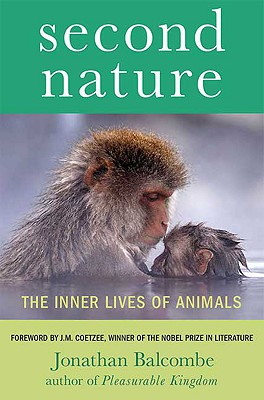
Author: Jonathan Balcombe
Hardcover: 256 pages
Publisher: Palgrave Macmillan
Language English
ISBN-10: 0230613624
ISBN-13: 978-0230613621
I remember as a child eating meat products with names like ‘jellied veal’, ‘liver-sausage’, ‘corned beef’, ‘hazlet’, ‘ox-tail soup’ and ‘tongue’. They were just labels at the time, for things I put in my mouth. Only much later would I associate them with animals.
Now, reading Jonathan Balcombe’s new book ‘Second Nature – The Inner Lives of Animals’ I’m asking myself why it took so long to make that rather obvious connection. In fact, it’s got me thinking about a whole host of issues related to how we as a species perceive and treat other animals – nonhuman beings as Balcombe prefers to call them. For the issues Second Nature addresses have as much to do with human morality and ethics as they do with animal behaviour.
Balcombe wants to open our eyes to the possibility of accepting animals as fellow sentient beings, with feelings and emotions as real to them as ours are to us; beings with lives that are pleasurable and worth living for their own sake; lives worthy of sensitivity and respect. As Balcombe puts it: “My chief aim in this book is to close the gap between human beings and animals – by helping us understand the animal experience, and by elevating animals from their lowly status.”
He begins by setting out the evidence for animal sentience, emotion and feeling, then discusses the implications this has for human attitudes and actions.
Part I summarises the findings of numerous field and laboratory studies that demonstrate a range of animal capabilities, experiences and sensitivities we usually associate more with people. Part II is a description of how animals use these qualities to interact and communicate between themselves and with other species, including man. Part III focuses on the relationship between humans and animals, and includes a discussion on popular perceptions and how they are changing with what Balcombe sees as an emerging new paradigm in attitudes and awareness.
Central to Balcombe’s plea is the assertion that humans and animals differ in degree rather than kind. Each type of animal, Balcombe says, including man, has evolved to operate in its own world, or ‘umwelt’, equipped with an appropriate package of sensory experience and feelings suited to that world. We shouldn’t assume life experience in one umwelt is inherently superior to that in another. Humans can never directly experience another animal’s umwelt (who can say what personal echo-location or magnetic navigation feels like? – to use Balcombe’s examples) but we accept that animals have complex sensory capabilities. Which begs the question why, when emotions and feelings are at least as real and necessary to us as senses in explaining our lives and behaviours, would we deny them in animals? Second Nature is certainly thought provoking on these questions.
Many readers will I expect, from watching natural history on TV or casual reading, recognise something of the better known case studies about Washoe the chimp, grieving elephants, and intelligent ravens. That said, the number and diversity of cited studies is impressive, and most of the content is new to me.
Take Kelly the dolphin for example, who was taught to trade paper litter found in her pool for fish, but discovered the fish flow could be maximised by trading smaller pieces of paper torn from a larger sheet she had stashed away at the bottom of the pool. And tests for empathy, where increased stress reactions were measured in animals who witnessed the suffering of another animal – not necessarily of the same species.
Consciousness is a key theme in Second Nature, with Balcombe describing how chimpanzees have demonstrated a ‘theory of mind’ by showing they are consciously aware of consciousness in other chimps.
Other studies support the proposition that animals, elephants for example, follow individual lives that are the product of their unique experience. And that animals, like us, deal with feelings over the short and long term; they remember experiences, their memories shaping what they become. There are even indications that elephants have a sense of the future and their own mortality. Further examples illustrate conditions ranging from depression in starlings, to post traumatic stress disorder in elephants, to anxiety in mice – including their remarkable ability to self-medicate.
Exploring the relevance of instinct, intelligence and language, Balcombe rejects simplistic models that associate instinct with animals and intelligence with humans. Instinct does not preclude conscious experience, and intelligence is not a good measure for moral standing. As Balcombe puts it: “Animals are as intelligent as they need to be”. The evidence shows that many animals, far from following some kind of invariant program, are capable of learned behaviour and can adapt flexibly to new challenges. And as regards language, as it’s not linked to sensory activity, animals are able to suffer with or without it.
Balcombe closes the animal-human gap from both directions, elevating our opinion of animal capabilities while questioning the superiority of our own. We are reminded that animal senses and capabilities – physical, and on occasion mental – can be superior to ours. Balcombe points to our penchant for industrial scale cruelty and destruction, questioning our right to label other species as uncivilized. Our culture, Balcombe says, particularly through the media, overplays the negative aspects of animals’ lives, pushing the ‘red in tooth in and claw’ image of a natural world where animals permanently struggle at the edge of survival, flailing at the smallest injury.
Part III sees Balcolme getting into his narrative stride, explaining where he thinks our relationship with animals might be heading. Under the heading ‘A New Humanity’ he describes a shift from a traditional attitude of ‘might makes right’ towards a more informed and caring paradigm – a transition he likens to the changes of mind-set that accompanied the end of slavery and the winning of womens’ rights. The process has already started, with impacts most tangibly captured in animal related legislation for the protection of species, improvements in the treatment of animals we eat, and tighter controls on laboratory animal experimentation.
Interestingly, with Second Nature appealing mostly to our moral sense, Part III includes some purely practical, well stated, arguments for reduced meat consumption based on health, resource conservation and sustainability. This leads to a brief politico-economic discussion on the compatibility of the capitalist/growth model with sustainable environments; inflammatory territory which Balcombe handles with a welcome non-emotive sense of balance.
The somewhat uneasy relationship science seems to have with the idea of animal feelings is one I find interesting in it’s own right. Balcolme, a scientist himself, criticises science’s tendency to favour the simplest of plausible theories. It’s one reason, he says, why we have the dogmatic starting assumption that animals don’t have thoughts and feelings, rather than the other way around. Conversely, Second Nature and other works on a connected theme (Masson’s and McCarthy’s ‘When Elephants Weep’ comes to mind) are particularly open to criticism when authors use language outside the scientific lexicon. There may be concensus on what sentience means, consciousness less so; but what to make of words like goodness, compassion, and selflessness? Personally, I don’t have a problem with Balcombe’s style because I don’t see the issues being wholly resolvable with today’s science; we’d need a workable scientific model of moral behaviour for that. A scientific proof isn’t going to pop up and tell us to treat animals better, no matter how many books we read. However, and I suspect this is where Balcombe is coming from, I do think science is the best tool for revealing true animal states that might then be judged logically incompatible with, or at least challenge, established moral and ethical standards. Of course, how established those standards ever are is a discussion for another day.
On a critical note, and it’s probably the scientist in me kicking up, there were times when I wanted more detail from the case studies, more counter-argument, and deeper discussion of skeptical views. That the early chapters are crammed with properly referenced case studies is a good thing but, in a work of this length, that means trade-offs in content. The shear volume of examples also gives the early chapters something of a ‘listy’ feel, although that corrects in the later, more analytical material. Also, I thought the singling out of Richard Dawkins and Daniel Dennett for criticism was unnecessary and unhelpful, particularly so when Dawkins has discussed the positive implications for animal rights that discovery (or creation) of a hypothetical man-ape hybrid would have. Examples of the darker side of nature, like the apparently cruel egg-laying behaviour of parasitic wasps, are perhaps over-quoted by the atheist camp, but only as arguments against the existence of a benevolent god, not a celebration. Moreover, Balcombe might want to keep the secularists on his team.
Despite these minor niggles, I have to confess Second Nature has caused me to think more deeply than I otherwise would about a topic I’d mentally parked. Commendably, it brings all the relevant issues up to date in one concise volume, and has plenty of references for those who want to dig deeper.
Will Second Nature change readers’ attitudes towards animals? I think in some cases it will. What it won’t do is resolve any consequential moral dilemma we might have around that next burger purchase. That’s something each of us must think about quietly on our own.
Related posts on Zoonomian that may be of interest
Interview with Alan Mootnick, Director of Gibbon Conservation Center, Santa Clarita, CA
The Open Ground. Conference podcast. Conservation, biodiversity)
Also of interest on other blogs
Carl Zimmer on ‘What it’s like to be a bat’ (Discovery Blog Sept 2010)