The asteroid Vesta is well placed for viewing at the moment in the constellation Taurus. From Earth, it appears as a mere pinpoint of light; so here’s an image NASA made earlier with the Dawn spacecraft that’s been orbiting Vesta for much of 2011/12:
The asteroid Vesta (NASA)
Just too dim for the naked eye, at Magnitude 6.34, Vesta is easily picked out with binoculars or a digital camera. I took these snaps on 15, 26, and 29 December in mixed conditions, including a nearly full moon and Christmas lights for the shot on 26th. So not the best quality you’ll ever see, but satisfying all the same – at least for me – to capture a 326 mile wide lump of rock hurtling against the starry background.
Vesta is presently about one and half times the distance of the Earth to the Sun away from us (1.65 Astronomical Units).
Vesta 15/12/2012Vesta 26/12/2012Vesta 29/12/2012
Vesta is easy enough to find with software like Starry Night. It also shows up on Sky Walk for the iPad, but not with sufficient accuracy to locate it with confidence. There again, if you simply point your camera at the bright red star Aldebaran in Taurus, and take a couple of one or two second exposures of the area with a few days between them, Vesta will give itself away as the only object moving over time.
Location of Vesta (Starry Night software)Vesta location 29/12/2012 (Starry Night software)
Having missed the peak of the Geminid meteor shower this year; or rather experienced it through icy fog in London, it was a bit of a bonus to catch this picture at 3.00 am this morning during a visit to Leicester.
Detail in the meteor trail shows it flashing / breaking up / colour changes
Whatever the meteor shower, this is my favourite bit of sky, so that’s where the camera gets pointed. This is one of a series of 15 second exposures at IS0 1600, f4, focal length 17mm on my Canon 7D.
What more could you ask for: Orion with sword, Hyades and Pleiades clusters in Taurus, Jupiter passing through, and a Geminid meteor to top it off.
Just goes to show it’s worth heading out in the dark and the cold for ‘one more go’.
Sky was quite artsy this morning, waiting for the cloud to clear
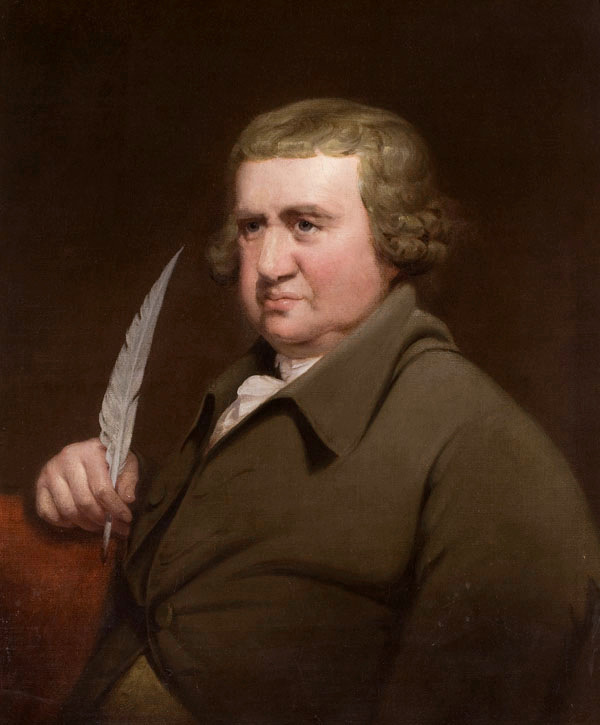
We shouldn’t let the day pass without a thought for Erasmus Darwin, whose birthday it is today.
Erasmus Darwin by Joseph Wright of Derby 1792 (WikiCommons)
Erasmus was born on 12th December 1731, at Elston Hall in Nottinghamshire.
During his seventy year span, Charles’s illustrious grandfather made more and varied contributions to the world of ideas than many today would guess – if they’ve even heard of him.
Erasmus is also of course the spirit behind Zoonomian; here are a couple of earlier posts that sum up his achievements and involvements:
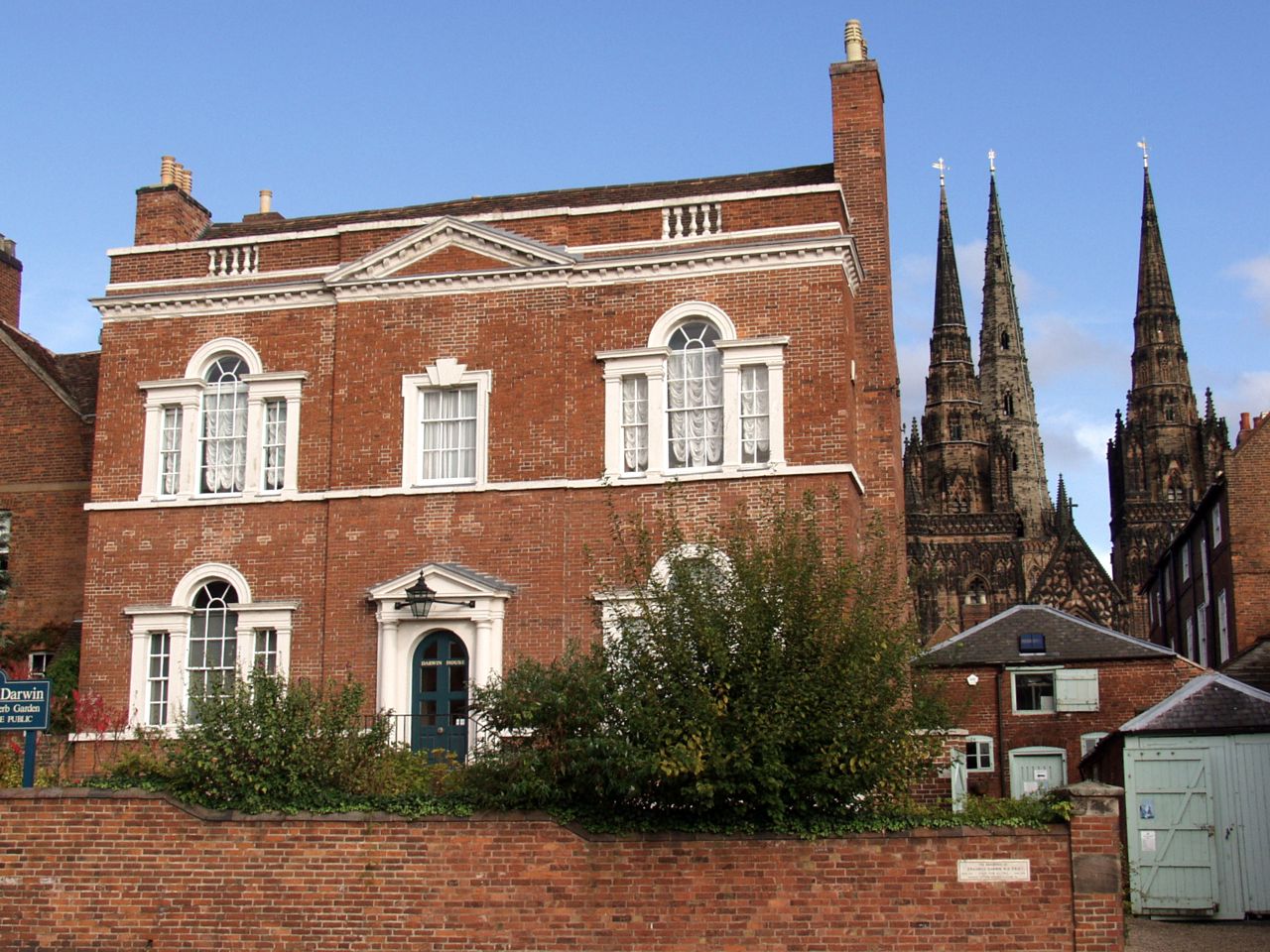
Erasmus Darwin House in Litchfield (Photo:Tim Jones)
Erasmus set up his medical practice in Litchfield, where he lived from 1756 to 1781. His house, now the Erasmus Darwin House Museum, is close to the magnificent cathedral, and well worth a visit. (Samuel Johnson also lived in Litchfield, so you can visit his house while you’re there.)
Litchfield Cathedral (Photo: Tim Jones)
Erasmus spent the last two years of his life at Breadsall Priory, where he died on April 18th 1802, aged 70.
Breadsall Priory, where Erasmus Darwin died in 1802 (Photo permission S.Klinge)
To round off, here are three excellent and recent videos on Erasmus courtesy of History West Midlands:
Erasmus Darwin at The Heart of The Litchfield Enlightenment
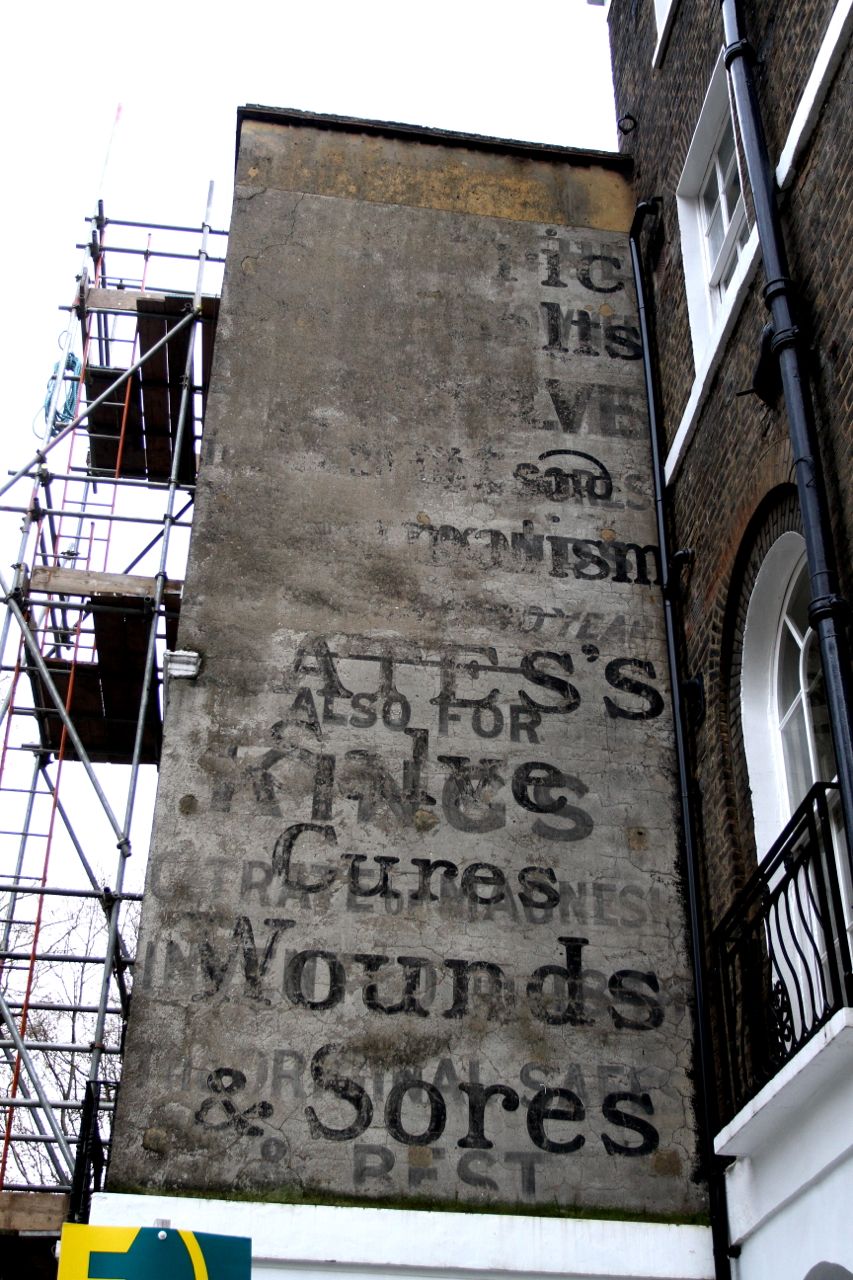
Old advertisements for medicines on a wall, corner of Regent’s Square / Sidmouth Street, London (Photo:Tim Jones)
Aspirin by any other name
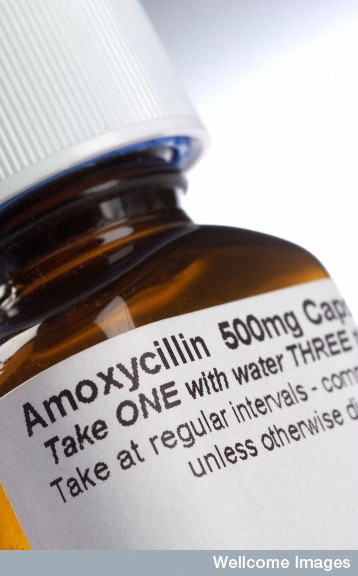
Drugs have at least two names: a generic or scientific name, and then any number of manufacturers’ brand names for what is essentially the same thing.
So the generic names for two well-known painkillers are aspirin (acetylsalicyclic acid) and paracetamol (acetaminophen), but on Wikipedia you’ll find at least a hundred alternative brand names for paracetamol alone. My favourites are the cuddly ‘Panda’ and the bemusing ‘Europain’.
It’s done of course to differentiate a commercial product, or identify a mixture of drugs – like aspirin and caffeine in Anadin. But it hinders keeping track of particular chemicals that suit you, for a cold or whatever. Also annoying are brands that list different drugs by application under the same headline brand, especially when the contents vary between countries.
Ghost Sign
As much as I enjoy banging on about how brands can obfuscate choice and cloud rational decision-making – and not just in medicines – this post is really about that photo of a building above, that I took yesterday in Regent Square, London. It’s an unlikely and incongruous survivor. A wall covered in early hand-painted advertisements for medicines from a bygone age. It’s a ghost sign.
Probably Victorian, when salve and laxatives were all the rage, the full spiel for one of the products, ‘King’s Citrate of Magnesia’, made by Bates & Company, reads:
King’s Citrate of Magnesia
Invented in 1844
The Original Safest
& Best
W.W. King was a Liverpool chemist of mixed fortune. I found him listed twice in sources for 1851. First as a prize winner in the Catalogue of the Great Exhibition1 – for his ‘effervescent citrate of magnesia’, but also in Charles Dickens’s Household Narrative2 for that year, in his regular round-up of bankrupts.
King’s Effervescent Citrate of Magnesia won a prize at the Great Exhibition of 1851
Citrate of Magnesia induces a Motion
It was no secret that the article was entirely wanting in both citric acid and magnesia3
The Pharmaceutical Journal and Transactions, October 1, 1870
Magnesium Citrate, or Citrate of Magnesia, is still used as a uncontentious saline laxative and magnesium supplement. But it has a 19th century history that echos some of today’s complexities around drug names, descriptions, and branding.
We expect boxes and bottles of medicine to contain what the label says. But by 1870, a situation had developed where products labelled citrate of magnesia were more often than not found to contain a mixture of “tartaric acid, sugar, and carbonate of soda3 “. It made for a nice fizzy summer drink, but little else.
A hapless public bought the mis-named drug in spite of the unrealistically low street price; it wasn’t like they could slip on glasses and read the small print, because compulsory ingredients listing hadn’t been invented. That some brands, including King’s (of our wall fame), appeared to ship the real deal didn’t simplify the big picture.
All this threatened the reputation of professional pharmacists, so, as reported in the October 1st 1870 edition of the Pharmaceutical Journal and Transactions3 , some of them met to discuss a formal motion that would set things right – they hoped.
What’s in a name?
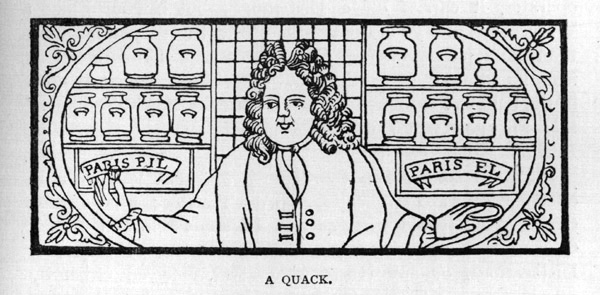
19th century Britons got their medicines from a variety of sources: via a doctor’s prescription, from an apothecary, chemist, or druggist, but also as commercial articles from the general store or local grocer. It’s like us going to the doctor, the pharmacy at Boots or RiteAid, or shopping at Tescos or Walmart. The difference is we get the same drug wherever we go, while for 19th Century folk it was more of a lottery. General commercial outlets were especially problematic – where unscrupulous quacks plied their mischievous trade of old. At worst, the more renegade outlets might be guilty of “applying definite chemical names to articles not having the composition thereby designated3 “.
A quack from an earlier age (Credit:Tufts University)
The pharmacists thought renaming the product might be the answer, but that idea just got them in a mess. Do you call a thing what it is, or what it should be? Suggestions included “citrate of magnesia of commerce“, “citrate of magnesia so called” , “citrate of magnesia of pharmacy“, “granular effervescent citrate of magnesia“, or the more vague “granular effervescent salt“. Also names closer to the common composition, like “granulated tartrate of soda“; or “citro-tartrate of soda” – whose sponsor claimed special privilege because it was already listed in the British Pharmacopoeia (an early list of approved drug standards published in 1867).
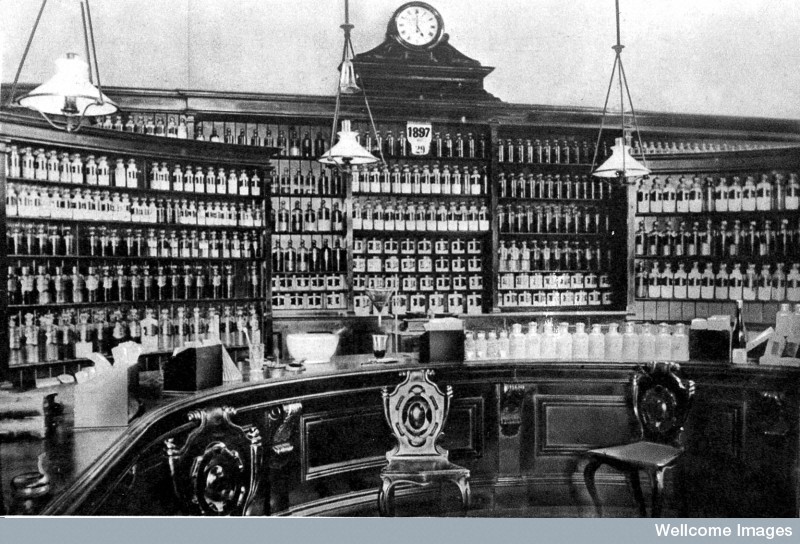
Interior of typical victorian pharmacy (Credit: Wellcome Library London)
In the end, relative sense prevailed, with options smacking of inaccuracy and deception, however pragmatic, being rejected in favour of scientific purity.
…this Conference, as representing and expressing the highest aims of pharmacy, ought to maintain a scientific purity and exactness in its nomenclature3
The Pharmaceutical Journal and Transactions, October 1, 1870
Not that everyone was behind an honest naming regime. It would confuse the public, said some, and open a Pandora’s Box of renaming obligations; hundreds of ambiguous favourites would be challenged: from ‘Salt of Lemons’, to ‘Seidlitz Powders’, to ‘Soda Water’.
From this strained conflict of pragmatism with scientific integrity a final motion was passed: a bit lame on specific actions, but a signal that professional pharmacists would not countenance inaccurate naming driven by commerce or tradition. At least for Citrate of Magnesia that is, by now firmly established as the tip of a misnomer ice-berg.
That this Conference is of opinion that the term ‘citrate of magnesia’ as applied to the ordinary granulated preparation of commerce is a misnomer, and ought to be discouraged as inconsistent with the true interests of pharmacy.3 (The final form of the motion)
The Pharmaceutical Journal and Transactions, October 1, 1870
Legislation
Motions from professional bodies are all well and good, but they’re not law. ‘Discouragement’ without legislation is toothless, and laws in this area had been slow in coming and often contested.
Prosecutions for drug misnomers were brought under the Food Adulteration Act (Photo: Tim Jones)
Earlier legislation, like the Apothecaries Act of 1815, defined standards and training for licensed apothecaries without actually outlawing unqualified practitioners, druggists, or quacks. The Medical Act of 18584 was more about regulating doctors, and explicitly excluded from its provision chemists, druggists, etc. involved in the sale of medicines (although it did action the earlier mentioned British Pharmacopoeia).
The Pharmacy Acts of 1852 and 1868, established under the auspices of the pharmacists’ own professional society – the Pharmaceutical Society of Great Britain (est 1841) gave them powers to control drugs, and may explain why this was such an issue in 1870. But with those acts focused on poisons and dangerous drugs, legal actions against peddlers of mis-named versions of the pedestrian citrate of magnesia were brought under the more generic Food Adulteration Act (1860) or Adulteration of Food and Drugs Act (1872). Coincidently, these same legislations helped reduce the sawdust content of sausages, and alum and chalk in bread.
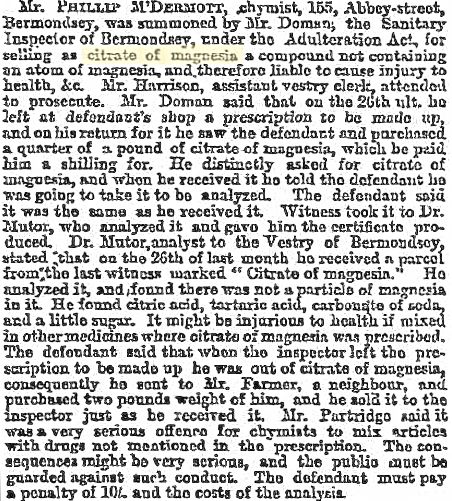
In this 1873 case, the defendant was found guilty under the Adulteration of Food and Drugs Act (1872), and fined £10 – about £1000 today – plus the cost of analysing his product:
Prosecution under the Food Adulteration Act for mis-selling citrate of magnesia (The Times, Nov 1, 1873)
Gradually things moved along, with further legislation on dangerous and controlled drugs appearing in the 1920s. The Medicines Act 1968 split drugs into the prescription, pharmacy, and general sales categories we have now. The naming of medicines in the UK is today administered by the Medicines and Healthcare products Regulatory Agency (MHRA), an agency essentially tasked with resolving the sort of issues our pharmacist friends were facing in 1870.
There’s no doubt controls over the naming and description of medicines has progressed massively since 1870. But with outstanding issues around the labelling and promotion of homeopathic products, and the classification and control of herbal remedies, the job’s far from over.
References
1. Official Catalogue of the Great Exhibition of the Works of Industry of All Nations 1851, Cambridge University Press, 2011
2. The Household Narrative of 1851, Ed Charles Dickens
3. The Pharmaceutical Journal and Transactions, October 1, 1870, P.275
4. Medical Act of 1858 (here at legislation.gov.uk)
This website uses cookies to improve your experience while you navigate through the website. Out of these, the cookies that are categorized as necessary are stored on your browser as they are essential for the working of basic functionalities of the website. We also use third-party cookies that help us analyze and understand how you use this website. These cookies will be stored in your browser only with your consent. You also have the option to opt-out of these cookies. But opting out of some of these cookies may affect your browsing experience.
Necessary cookies are absolutely essential for the website to function properly. This category only includes cookies that ensures basic functionalities and security features of the website. These cookies do not store any personal information.
Any cookies that may not be particularly necessary for the website to function and is used specifically to collect user personal data via analytics, ads, other embedded contents are termed as non-necessary cookies. It is mandatory to procure user consent prior to running these cookies on your website.