Darwin, Dennett and Dumbo’s Magic Feather

Since I  posted this blog, the BHA have issued a video of the whole event. So for a summary – read the blog; for the whole smash…here it is!

Disney’s Dumbo the Elephant got rid of his magic feather.   He realised it was  just a temporary crutch that gave him the courage to be all that he could be.

For philosopher Daniel Dennett, speaking on ‘A Darwinian Perspective on Religions’ , religion is just like Dumbo’s feather – a crutch we can do without.   This is a summary of the British Humanist Association (BHA) event I  joined earlier this month at South Place Ethical Society’s Conway Hall in London.
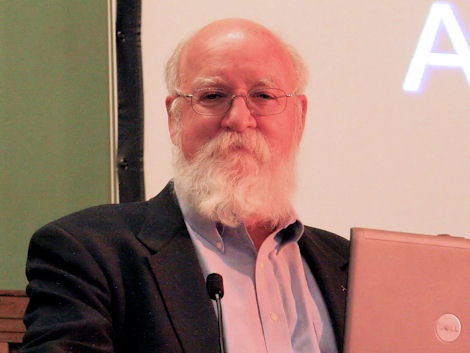
Daniel Dennett speaking at the BHA event at Conway Hall
Daniel Dennett speaking at the BHA event at Conway Hall (photo Tim Jones)

Chairing this second lecture in the BHA’s  Darwin 200 special lecture series, Richard Dawkins  introduced  Daniel Dennett as the scientists’ philosopher; someone who takes time out to keep up to date with the scientific literature.  And strangely perhaps, it is Dennett the philosopher, not Dawkins the scientist, of these two champions of atheism, who tends to take the more studious, less obviously attacking,  line on religion.
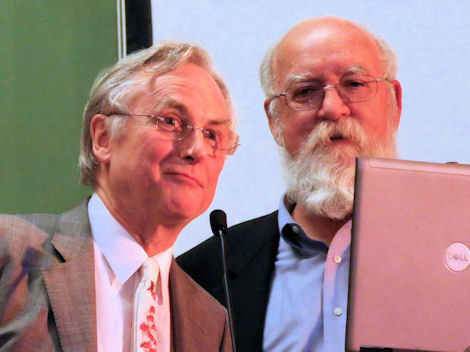
Daniel Dennett with Richard Dawkins at Conway Hall (photo Tim Jones)

Taking to the podium in cheerful good humour, prompted in part by the obvious similarity between his own bearded visage and that of the cardboard Darwin cut-out standing stage left, Dennett launched enthusiastically into the reverse engineering of religion.

What was in store for the world’s religions?  Would they sweep the planet?  Would they die out rapidly or drift out of fashion –  like the smoking habit ?  Or would they transform themselves into creedless moral entities – keeping up the good work but without the mumbo-jumbo?    Whatever the future holds  for religion, Dennett’s mantra is that if we are going to have any steer over it, we had better  understand it – from a scientific point of view.
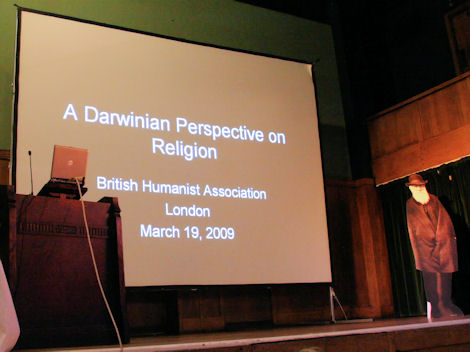
A Darwinian Perspective on Religion (Photo Tim Jones)

Dennett treats religion as a Darwinian phenomenon.  Human beings put a lot of energy into it – so what’s the biological justification behind it?

Religions, Dennett argues,  are the inevitable product of word evolution.   He see words simply as memes that can be pronounced.  Memes – the name coined by Dawkins  to describe units of cultural information transfer that are  in some ways similar to genes.   Further, words and letters represent a digitisation of language, meaning they can be accurately replicated – even without understanding, because of their consistency with a semantic alphabet.  So however crazy an idea expressed in words might be, it can still multiply irrespective of its meaning being understood or making rational sense.

How might the first word memes have come about?   Using a Darwinian analogy,  Dennett likened the first word memes  to wild animals evolving through natural selection in which “evolution is the amplification of something that almost never happens” .   As such, it would only have taken someone to give an arbitrary  name to a strange noise in the woods one day (fairy, goblin, monster etc.), for that name to eventually get around a wider community.  The seeds of superstition would have been sown.   Some  notable memes, by virtue of a special repulsiveness  or  attractiveness, would have survived into folklore.   It is these memes, Dennett said, that are “the ancestors of the gods” at the core of the world’s religions.
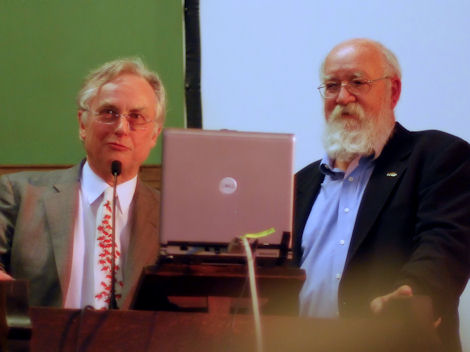
Richard Dawkins and Daniel Dennett (Photo Sven Klinge)

But that was only phase one.  When these ‘wild memes’ are purposefully looked at, studied, and manipulated by people, they become more powerful.  Some humans (e.g.priests) might dedicate themselves to keeping such memes alive and thriving,  even when by themselves they are no longer very convincing.   The modern religions resulting from this process and  that still survive today represent a tiny fraction of all past religions, and are analogous to surviving languages or species.

Good design means these husbanded memes have inbuilt mechanisms for survival.  For example, many religions make man a ‘slave to the meme’ – it’s called subservience.

Dennett described an interesting possible influence of the placebo effect in our cultural religious development.  Human susceptability to ritual may be a result of our reproductively successful ancestors being the ones who – through receptiveness to placebo – enjoyed the health benefits of shaman ritual.   Other self-maintenance devices built into  modern religions include the glorification of incomprehensibility, warnings not to engage with reasonable criticism (on the basis that you’re talking to the Devil, and he’s a better debater than you), and the idea that a belief in a god is a pre-condition for morality.

And that brought Dennett near to his close, and us full circle to Dumbo, and the argument that we have religion because we need it.  Dennett argued we no longer need the crutch represented by Dumbo’s feather.   Indeed, it’s harmful to hang on to religion, what with the likes of cult suicides and  death sentences for blasphemy.   But religion is most harmful  as a threat to a rational world view.   And how does religion differ from other factors that disable rationality, such as drugs or alcohol?  Only religion, Dennett said, “honours the disability”.

Also Interesting – Dennett’s debate last year with Robert Winston
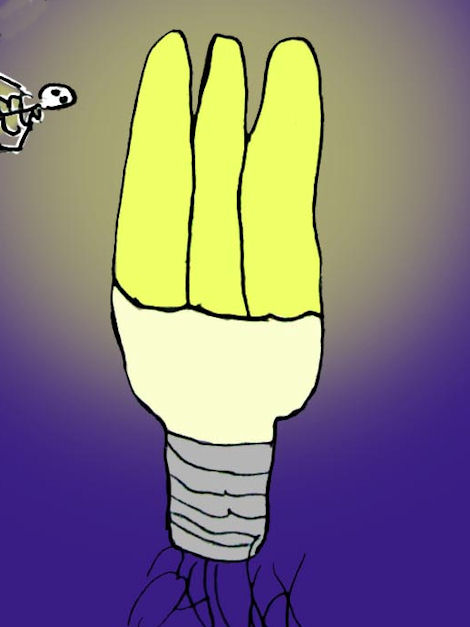
Earth Hour – Consciousness Raised? (a bit?)

Well that’s the World Wildlife Fund’s ‘Earth Hour’ over and done with for another year.

earth-hour
(Artwork - Gareth)

At least that’s the cynic’s (realists?) view of this annual attempt to get the world’s lights switched off for an hour, on a rolling cycle from 8.30 – 9.30 pm, across the globe.   It’s just happened in the UK.

I’ve heard the arguments for and against what some see as a ‘stunt’.   I support it all the same.

Whatever else the organisers intended, events like this raise consciousness in those they touch – even if that excludes the worst offenders.

Against that is the view that one-off gestures make people feel good at the time, but that real benefit is lost in ‘business as usual’ during the year.  I’ve not seen any statistics, so won’t comment; maybe the WWF have done the research?

But I can’t get excited about criticism that people might actually use more power during the ‘lights out’ hour.   On balance, I hope there’s a reduction, but don’t see it as a huge deal if not.   I feel guiltier when I’m using power.

Events like Earth Hour raise consciousness; an essential ingredient in any discussion on global warming, religion, famine, conservation, or any number of contentious science-related issues.    The Earth Hour critics are right that you can’t force people to act, but you can nudge them in the right direction.   This is a preparing of the ground, warming people up gently so they don’t melt when faced with the full real cost of energy.   And rather than giving the impression that turning out lights will save the planet, Earth Hour might just spur some to follow up on the detail of the broader picture.

Next year maybe we need the ‘leave the X5 in the garage for a month stunt’, or the ‘cancel one of the two long-haul hols. stunt’?   A sustainable planet will require fundamental life-style changes –  to paraphrase Sir David King (again, sorry) at this year’s Darwin Day lecture: things won’t really sort themselves out until girls stop fancying blokes in Ferraris…… (go figure).

I did hugely exciting stuff in my dark hour.  First, I checked out the appartment building and found the lighting pattern pretty much as I remember it from any other Saturday night (no control – my not being scientific, sad, or both, enough to photograph the place over the two previous weeks).   Then to the supermarket with my re-useable plastic bag (by now I’m visibly radiating good-citizenship with my raised consciousness before me), arriving home 20 minutes early and requiring the PC be prematurely re-activated as a light source.

In that 20 minutes, I did the back-of-fag-packet calculation that a billion people (the WWF target) turning off a 100W  bulb = 100,000 MW or 200 power-stations at 500MW  or 100 at 1000MW.   My personal saving was much less than 100W, at  22W  for the 2 x 11W  fluorescent lamps we run in the lounge which, as a fraction of the power used by the 300W  TV  and 150W PC  found in most homes, supports the critics numerical case.   But if you think that’s what it’s about,  you’re missing the point.

Anyhow, off to phone my other half who’s in the USA at the mo’ – need to get those double Earth Hour Brownie Points.

Supping With The Devil

A short note on my latest reading – ‘The Jasons’ by Ann Finkbeiner.

jasons

The book tells the true story of a group of US scientists, ‘The Jasons,’ who still to this day get together for six weeks or so every summer to analyse defence and security issues, make reports, and propose technical solutions and further work to the US government.

The Jasons were, and are, real ‘A -List’ intellectuals from the worlds of physics, chemistry and biology. They choose the problems they are able and inclined to work on, and are self-selecting of new members – apparently without government interference.

The first Jasons were drawn from the Manhattan project pool, in the age of Dr Atomic; names like Edward Teller and Hans Bethe.

I’m not going to repeat the background: here is a NY Times review of the book and the Jason’s Wikipedia entry. But a few points stuck with me:

Ideas – the shear out-of-the-box / lateral thinking, call it what you will; these guys were having serious fun with serious issues. It’s not something the Jasons are most famous for, but Nick Christofilos’s idea in the 1960s to build one long continuous runway across the USA, so the Russians couldn’t pin down SAC aircraft, tickled me. He also pushed for beam weapons and ‘electron cloud’ defensive umbrella shields; the seeds of Regan’s SDI – however impractical and misguided. He proposed an Extremely Low Frequency (ELF) communication system for submarines, to deliver six words a minute at 25Hz; that’s a 7,400-mile wavelength requiring an antenna 8,500 miles long. One of the interviewees in the book says the system was built – wires were laid !

Motivation – there doesn’t seem to be one factor. The intellectual challenge – sure, but Finkbeiner puts patriotism high on the list too. Several Jasons have described a feeling of practical usefullness, a wish to expand their science into applied technology, to become engineers – multi-disciplinary at that. This touches on the differences between scientists and engineers….and other groups, which I find fascinating.

Despite a crying need for co-operation, there is still today much structural (e.g. funding) and cultural resistance to the inter-disciplinary ethos (I speak as an engineer who served time on the commercial dark side and now hangs out with scientists). As a related aside, check out this recent Los Alamos Study.

Of their time? Born of an acute Cold War terror, the founding Jasons’ revulsion to some of the military projects they got involved with, and the price they might pay in academic and popular reputation, was more than countered by their contemplating the result of inaction. Some Jasons felt they’d made ethical trade-offs, the magnitude of which wasn’t clear to them until it was too late. Are we in the same situation today? If you are a scientist, would you commit to work in total secrecy on projects the results of which might never be published?

And while ‘The Jasons’ deals with the great and the good of an academic elite, were not the dilemmas they faced and the decisions they made in many ways similar to those facing thousands of lesser known scientists and engineers who work in the defence industry?


Update 7/7/2011

Also of interest: article in Imperial Magazine on war and innovation (download pdf)

It’s Gibbon Time!

(This piece originally appeared as an editorial in Conservation Today. You can see/hear it elsewhere on this blog by clicking HERE.

Check out my latest editorial for Conservation Today for a more manageable (=edited)  form of the Jones-Mootnick gibbon interview at the Gibbon Conservation Center in Santa Clarita, California.

Young White Cheeked Gibbon

Search for Life in Second Life

A little bleary-eyed this morning, having stayed up to watch the Kepler launch on NASA TV.

Kepler’s mission is to locate rocky earth-sized planets around other stars.  The satellite carries an instrument called a photometer, or light meter, that measures the very small changes in a star’s brightness that occur when an orbiting planet passes in front of it.

The real interest is in worlds that orbit in a ‘habitable zone,’ not too near and not too far from their star, where liquid water, and possibly life, could exist.

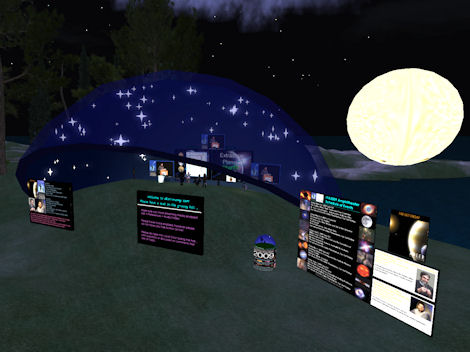
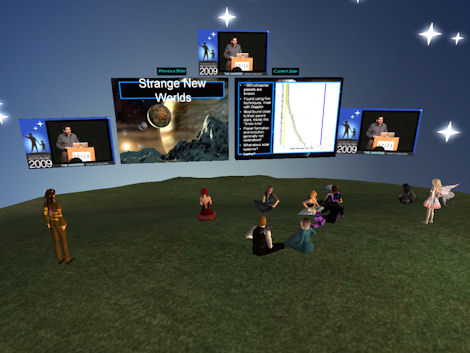
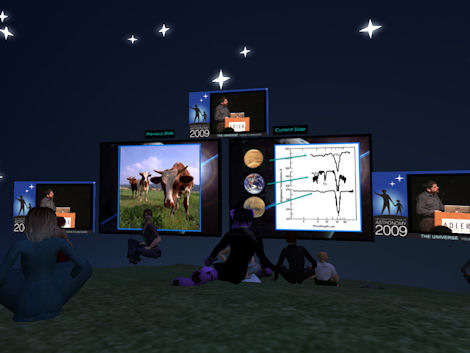
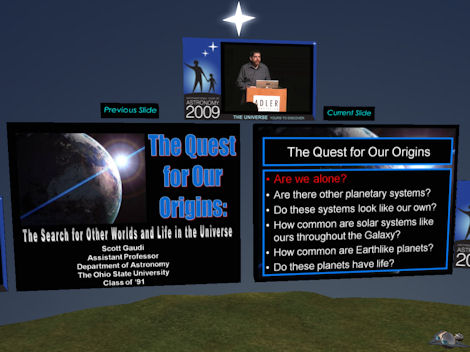
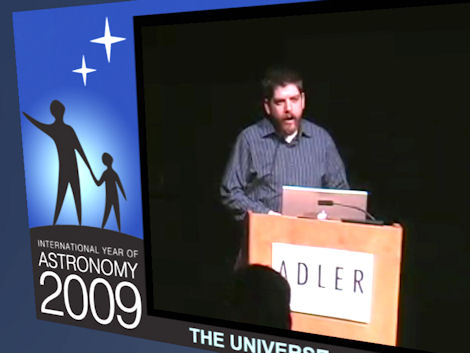
The build-up to Kepler has prompted much discussion around the possibility of extra-terrestrial life.  A couple of weeks back I joined ‘The Search for Life Beyond Earth‘  at the Royal Institution.  Last night, via a live feed into Second Life from Chicago’s Adler Planetarium, I joined Scott Gaudi of Ohio State University on a ‘Quest for our Origins – The Search for Other Worlds and Life in The Universe,’ including a review of the latest techniques for remotely identifying earth-like planets.

The technical quality of this event was excellent, with live streaming video, multi-screen slides, and sound.

There is another event tonight at 10 a.m Pacific Time (6 pm UK), about the early universe and the cosmic microwave background.  Just time for you to sign up; see you there (SL name Erasmus Magic).

Here are some photos from last night:

Auditorium in SciLands

Scott Gaudi speaking from the Adler Planetarium into Second Life
Multi-screen live presentation
The Quest for our Origins
Scott Gaudi
Scott Gaudi
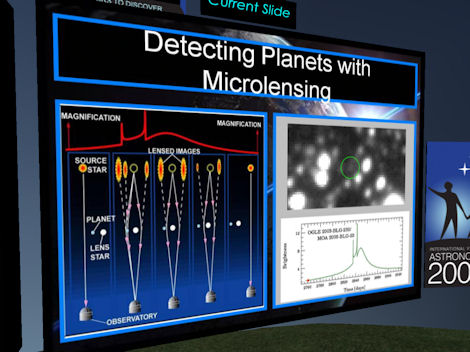
Microlensing (slide from Scott Gaudi's presentation)
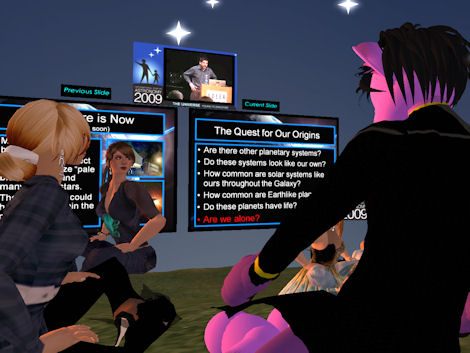
Colourful characters in SL