Mountains and Moonbows

What do aurora, noctilucent clouds, sun-dogs, and green flash have in common ?  Answer: they’re all examples of rare and interesting visual atmospheric phenomena I’ve totally failed to observe this summer.
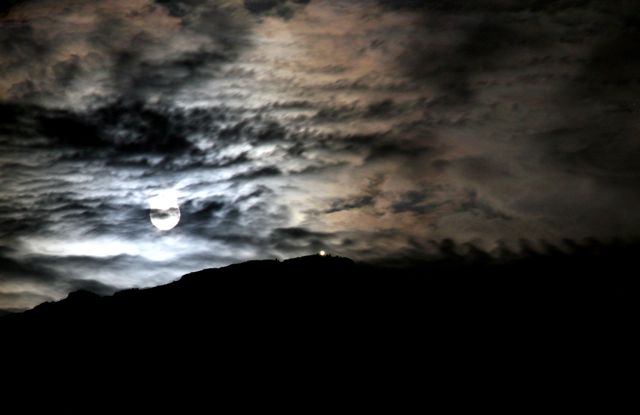
Lunar corona and Lenticular Clouds, Jungfrau Massive (Photo: Tim Jones, Darkroommatter.com)

Conditions have often been right, even optimal.  I’ve made repeated observations with sophisticated equipment: my eyes and a camera, but no joy.  The only solace for standing in a field staring at the twilight horizon for nights on end has been the proximity of the local hostelry.  On reflection not such a bad deal.

I’ve had better luck in the past, but more so with the moon than the sun.  Take the example above of a lunar corona in the Swiss mountains.  Snapped between avalanches from an improvised snow-hole during my ascent of the Eiger from the window of the Beau Rivage Hotel in Interlaken.

Lunar coronae are in no way attached to the moon, but are an earthbound visual effect caused by moonlight passing through clouds of small particles.  As it’s a diffraction effect rather than a refraction effect, it works even with particles that don’t transmit light, like pollen grains for instance.   In this case the effect is most likely caused by water droplets in clouds.  The same thing happens with the sun sometimes, the visual ‘corona’ in that case not to be confused with the physical corona that is attached to the sun – so to speak.

Talking of confusion, lunar coronae, or moonbows, are not the same thing as Moon Rings.  I made that mistake when I started writing this piece and subsequently had to change the title.   A Moon Ring is just a name, but it’s a name specifically reserved for a ring of light caused by the refraction of moonlight through high altitude ice crystals.  Because ice crystals are hexagonal in shape, they all refract light at the same angle, which from an observer’s viewpoint produces a ring concentric with the moon at a fixed radius of 22 degrees (for fuller explanation see here).  Measured across the sky, that looks like 44 moons put next to each other (the moon takes up roughly half a degree of the 180 degrees of the sky we can see at any time).  The ring in my picture is at most ten moon diameters from the moon’s disc, or five degrees.  So it ain’t a Moon Ring.

A lunar corona can be more spectacular though, and if the conditions are right, a whole rainbow of colours can spread out from the inner ring, going from red to blue.

On a different tack now….

Apart from the moonbow, this scene includes an almost text-book perfect example of a mountain weather phenomenon known as Mountain Waves and Lenticular Cloud formation.

Lenticular clouds over the Jungfrau Massive by moonlight
Blow-up of the scene above showing moonlit lenticular clouds forming over the Jungfrau Massive (Photo:Tim Jones)

When air is forced to rise by flowing up the side of a mountain, it can cool down sufficiently, to the dewpoint temperature, where water vapour  condenses to form clouds. (That is adiabatic cooling and cloud formation as first explained by Erasmus Darwin. Just sayin’.)  When the air descends on the other side of the mountain, it warms up to above the dewpoint and the cloud disappears, the water drops vapourising again.   The isolated cap left on top of the mountain is a lenticular cloud.

That said, what I think we’re seeing in the photo here is a special circumstance for lenticular cloud formation that I first came across as a trainee private pilot.  In this case, air flowing over the mountains is trapped under a higher layer of stable air, causing standing waves to be set up, with lenticular clouds peeling off the cusps.

Reminiscent of a Katsushika Hokusai painting

The same conditions generate a series of turbulent rotating eddies lower down on the lee side of the mountain which can cause so-called ‘rotor clouds’ or ‘roll clouds’ to form.   It’s best not to fly anywhere near areas of rotating turbulence, so these clouds are good visual warnings for pilots to take special care (although as the mountain wave effect can extend 30 or forty miles downwind of a large range, you’re just as likely to feel the warning).

For a close-up view of a lenticular cloud, here is a lenticular altocumulus I snapped this summer floating off the leeward side of the San Gabriel Mountains in California.  The bulges are caused by rotating air under the cloud.
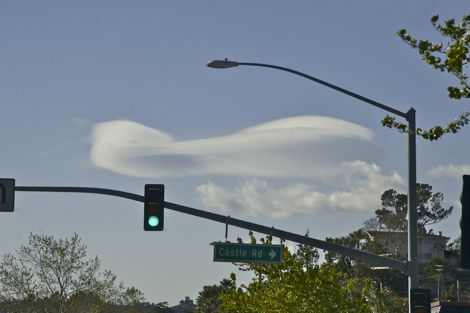
lenticular cloud formation off San Gabriel mountains in S.California
Lenticular cloud formation (Photo: Tim Jones)

That then about wraps it up for mountains and moonbows.  Just to leave you in the true spirit of transparent open-book research and a view of the laboratory where the Swiss studies were made, complete with proof of location.  And flowers.

Armchair atmospheric physics (Photo: Tim Jones)

Update November 2011 – Here’s another lunar corona; this time with Jupiter and taken from Kingston upon Thames:
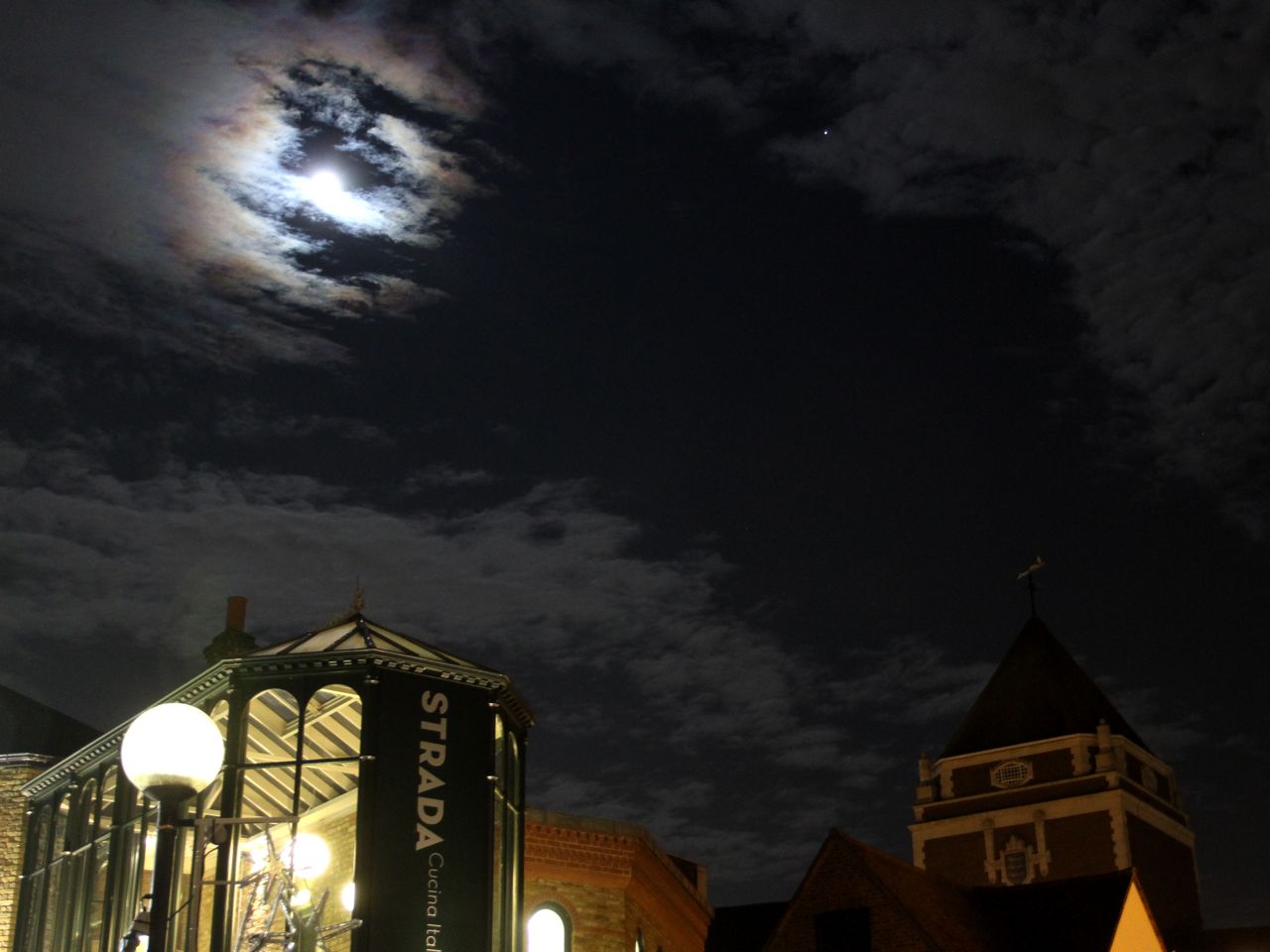
Moon with lunar corona and Jupiter

Of related interest on external sites:

Rare Green Flashes Captured from the Moon (Universe Today)

http://www.sciencebase.com/science-blog/cloud-spotting.html

http://blogs.agu.org/wildwildscience/2011/12/17/magic-clouds-in-the-magic-city/


Of Physics, Firearms, and Fireworks

Physics, Firearms, and Fireworks
(photo: Tim Jones)

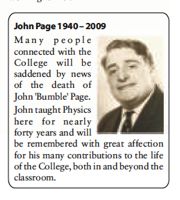
I learnt only recently, while researching the early use of computers in schools, that my physics teacher from the late seventies, John Page, had died during 2009.

Better known by his nickname ‘Bumble’ (possibly after the Dickens character), he was certainly a character himself.  He was also a teacher who encouraged me to think.

Reproduced from the Gateway Magazine

For sure, Bumble covered the official syllabus: wheeling out worthy but ultimately plain vanilla physics kit like air pucks, weights, and springs.  But the most interesting discussions – the ones that have stuck with me –  followed some of his more off-the-wall demonstrations.

For example, as an introduction to Newton’s Laws of Motion and the Gas Laws, Bumble kicked off one lesson by discharging a black powder pistol at the front of the classroom.

The lesson started in the usual way, Bumble making his signature ponderous walk to the laboratory’s front desk, eyes looking at the floor.  

Entirely normal so far, except today he carried a long-barrelled  revolver in his hand, one chamber of which he proceeded to load, methodically inserting pieces of cloth, then gunpowder, then cloth again (no bullet thankfully), before compressing the package with a small ram rod.  We watched in stunned silence.

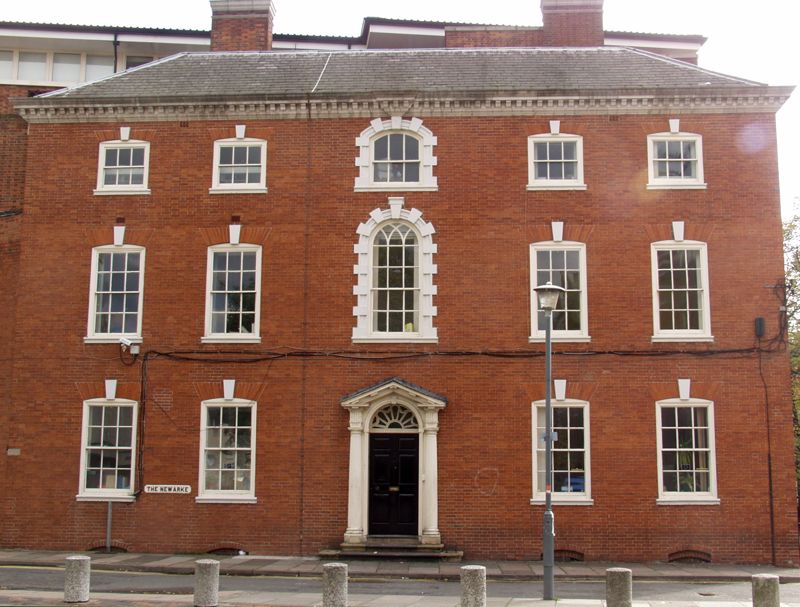
Gateway Grammar School Leicester
Gateway Grammar School, Leicester (Photo: Tim Jones)

Remember, this was all way before the Dunblane massacre or other school shootings, so I guess we felt a sense of intrigue rather than fear.  This was Bumble anyhow – he did weird stuff.   With a copper percussion cap in place, the gun was pointed in the general direction of the laboratory wall.  And fired.

Within seconds of the most enormous bang echoing through the now smoke-filled laboratory, the Head of Physics, Mr Gill, closely followed by the Head of Chemistry, Mr Scottow, tumbled into the lab looking suitably alarmed.  They’d clearly not been pre-briefed, and I still remember their expressions changing from shock to relief – and a glance of resignation between them – as the gunman stepped out of the smoke.

Stunts like Bumble’s Colt Navy revolver demo were attention grabbing and fun, but also an introduction to typically stretching discussions. 

In this case, Bumble got us thinking about how long a gun barrel would have to be before the bullet changed direction and went back the other way.  Imagine the thought processes needed for that.  First off, there’s the non-intuitive realisation that a projectile in a tube can change direction if the pressure behind it falls sufficiently relative to the pressure in front of it – which theoretically can happen in a long enough gun barrel.   Then there’s the skill of mentally extrapolating the familiar (relatively short barrel) to unfamiliar extremes (hugely long barrel).  Thinking in abstraction and at scales beyond normal experience is useful, for scientists and non-scientists alike, in appreciating the scales relevant to fields as diverse as evolutionary biology and cosmology (and presumably also super-gun design).

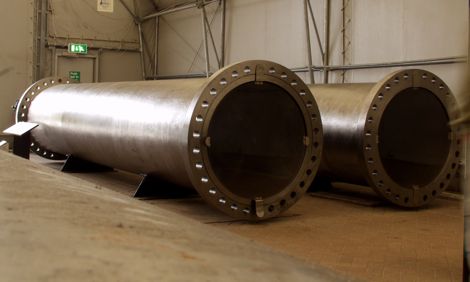
Sections of Big Babylon at Fort Nelson, Portsmouth
Sections of the ‘Big Babylon’ Iraqi super-gun at the Royal Armouries, Fort Nelson, Portsmouth (Photo: Tim Jones)

Then comes the actual physics and chemistry: mechanics, thermodynamics, kinetics, friction, shock-wave propagation – not to mention the mathematical tools needed (I don’t remember if we came up with an actual quantitative answer, and suspect an analytical solution is only possible with major simplification. )  The follow-on lesson might cover ballistics: catching up with the bullet after it leaves the gun.

In a similar vein, my introduction to fluid flow through constrictions and Bernoulli’s principle took the form of the largest firework rocket I’d ever seen being launched from the school playground.  In the lesson afterwards, we talked about rocket nozzle design.   It turned out Bumble was licensed to make fireworks and had designed and cast his own ceramic nozzles.  I still marvel that the thing came down ‘safely’ in the confines of the school yard.

So that’s how I remember Bumble.  We might at times have got distracted from the strict letter of the course syllabus; but that’s the nature of real-world problems if they’re studied with sufficient rigor.  And arguably as the antithesis of spoon-fed exam training, Bumble’s teaching style may not have suited all students.  But personally, I love the attitude and approach to education John Page represented, and very much hope we haven’t seen the last of the Bumbles.

Echoes of Muybridge – Photographic Pioneer

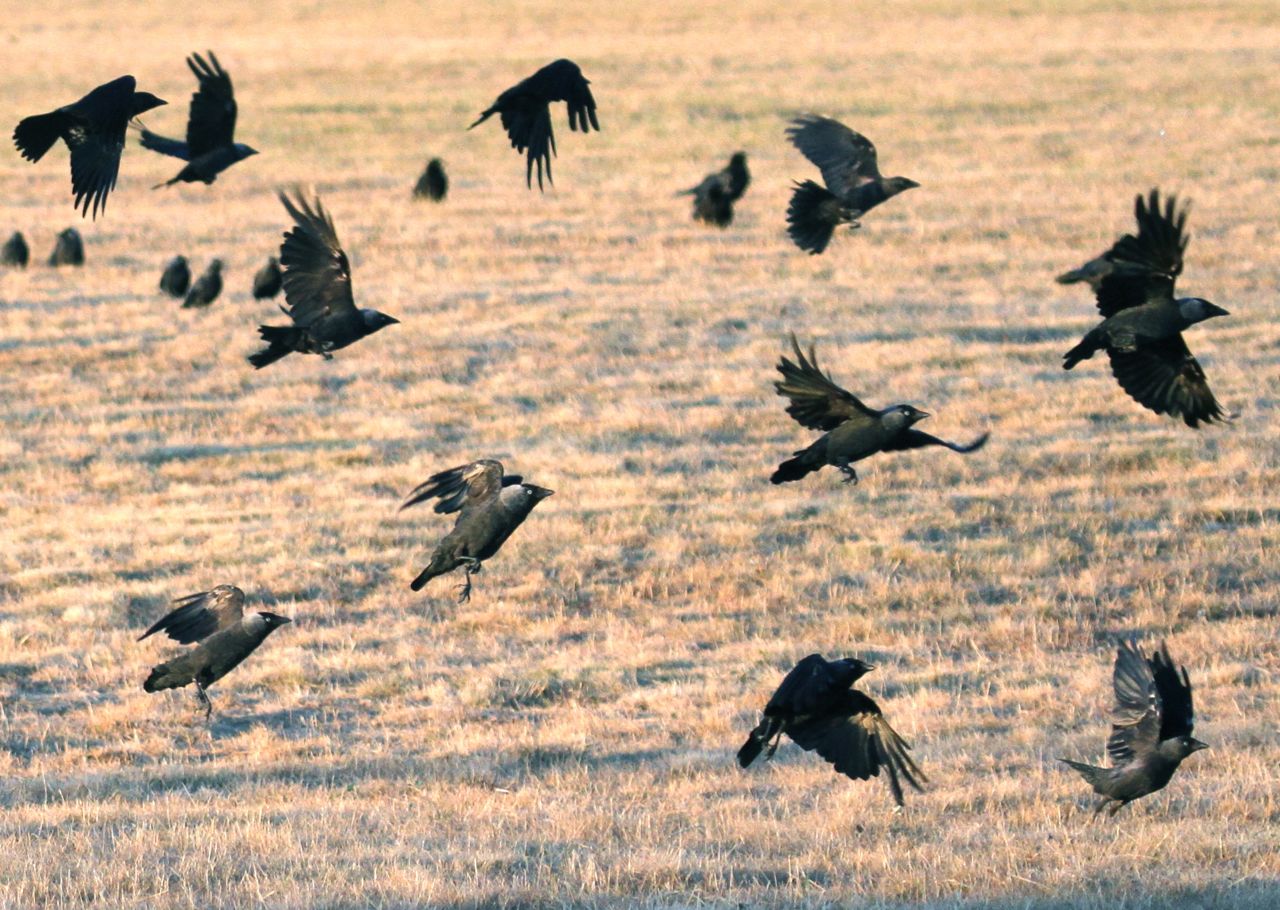
Do the four jackdaws taking off across the left-right diagonal here remind you of anything?

Jackdaws taking off
Was Muybridge inspired by their ancestors?  Click for larger image.  (Photo: Tim Jones, Darkroommatter.com)
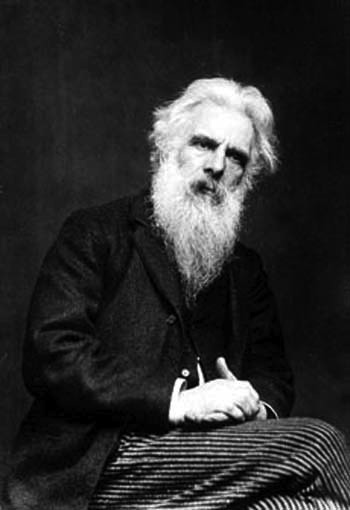
Eadweard Muybridge
Eadweard Muybridge (Photo: WikiCommons)

For me, the regular spacing and apparent connected motion of the birds is reminiscent of  the work of nineteenth century photography pioneer, Eadweard Muybridge.

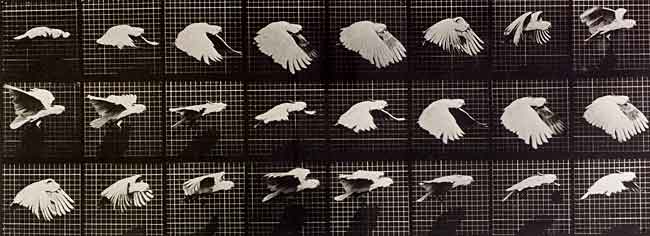
Born in 1830, Muybridge photographed many sequences of birds in flight like the one below.  But he’s probably better known for his animations of galloping horses, revealing for the first time that, at certain points, horses literally fly.

Eadweard Muybridge's Bird in Flight
Eadweard Muybridge’s Bird in Flight

Muybridge’s techniques revealed an animal’s true motion, knowledge that until his arrival had been lost in a blur of busy limbs.

Before photography, the motion of horses in motion was often mis-represented. Baronet with Sam Chifney Up, by George Stubbs.  (Photo: Tim Jones of a painting at Huntington Library)
Before photography, the motion of horses in motion was often mis-represented. Baronet with Sam Chifney Up, by George Stubbs. (Photo: Tim Jones of a painting at Huntington Library)

I should explain that Muybridge made sequenced compilations of stills taken of a single animal, while my picture is a happenstance capture of several birds taking off in close proximity and in apparent sequence: reminiscent of an airfield scramble or ducks flying up a wall.  So I’ve got an illusion evocative of Muybridge, not a simulation, and the motions of different birds cannot be linked. (Or can they? Formation take-off?  I’m reminded never to under-estimate the Corvidae family!)

By another happenstance, it turns out Muybridge was born and raised in the town where I now live: Kingston-upon-Thames in Surrey.  And while he spent most of his working life in America, Muybridge left the materials of his important photographic legacy to his home town, where they reside in the Kingston Museum and Archive, five minutes walk from where I’m sitting.

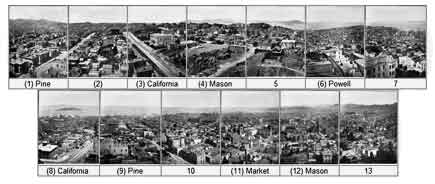
A good selection of Muybridge material is normally on display in the museum, representative of his animal and human figure work, but also featuring his definitive 1878 panorama of San Francisco (link to America Hurrah website).

Muybridge’s San Francisco Panorama (Photo credit: America Hurrah)

And if you’d like to find out more about Muybridge and his legacy, there couldn’t be a better time.  Beginning this week, Wednesday 8th September, the Tate Britain will launch a Muybridge retrospective, and our own Kingston Museum will, from September 18th, host the Muybridge Revolutions exhibition, featuring unseen exhibits like Muybridge’s collection of Zoöpraxiscope discs.  The Kingston exhibition is part of a broader range of Muybridge related activities being coordinated by Kingston University with Kingston Council.

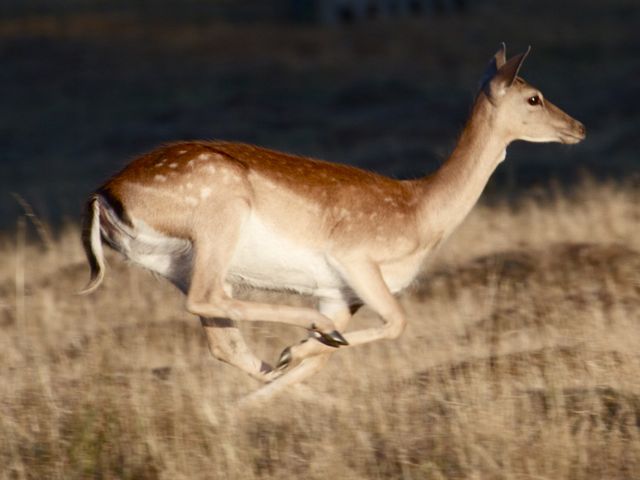
Fallow deer.  (Photo:Tim Jones, Darkroommatter.com)

But returning to my jackdaws in a more romantic frame.  I like to ponder Muybridge walking the same routes I take  today as I photograph the wildlife of Home Park; his meeting the ancestors of present-day jackdaws, deer and rabbits; and with his frustration at the unfathomable rapidity of their movements, the seed of motion photography being sown….

Update 12 October 2010

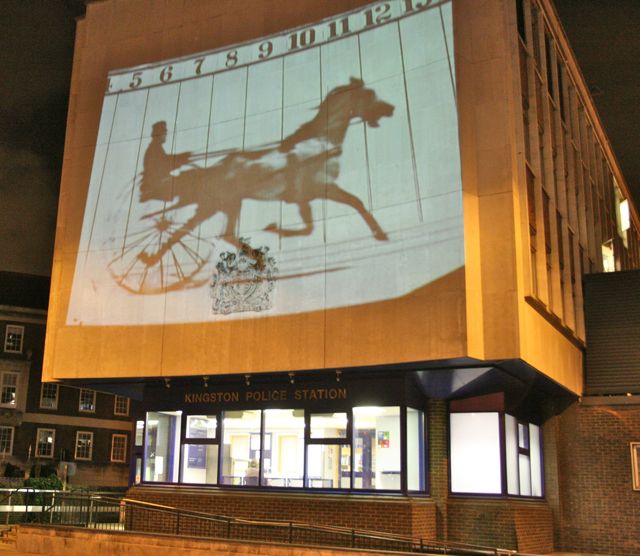
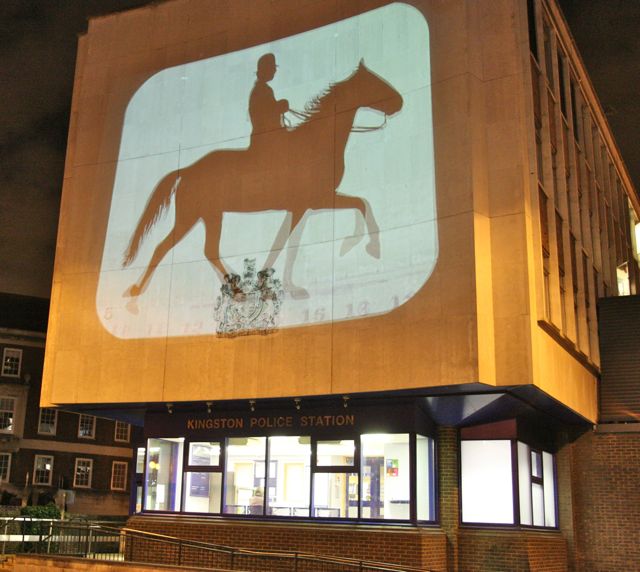
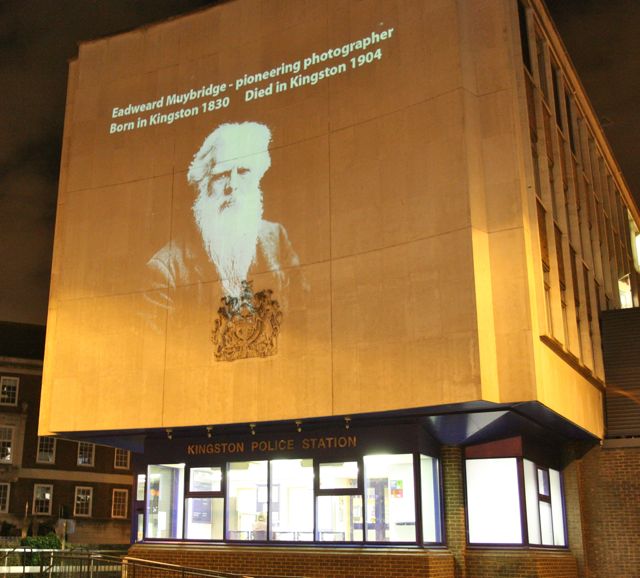
The powers that be are projecting Muybridge animations onto the side of Kingston on Thames police station. Very nice.

Muybridge on Kingston upon Thames police station
Muybridge on Kingston upon Thames police station (Photo:Tim Jones)
Muybridge on Kingston upon Thames police station
Muybridge on Kingston upon Thames police station (Photo: Tim Jones)
Muybridge on Kingston upon Thames police station
Muybridge on Kingston upon Thames police station (Photo: Tim Jones)